


 Astha ChadhaThe weems of data

Meld u aan om de nieuwste inzichten en updates over technologie, AI & data-analyse, datawetenschap en innovaties van Polestar Analytics te ontvangen.
 Vat dit blogbericht samen met:
| Gartner expects 60% of data-dependent projects to be abandoned by 2026 due to poor data foundations. An Anaplan readiness assessment is the cheapest way to make sure yours is not one of them, by surfacing data, process, resource, governance, and adoption gaps before the first model is built. |
TL;DR: Most Anaplan implementations that go off track do so because of gaps that existed before the first model was built. A readiness assessment checks five things before you start: whether your data is clean and connected, whether your planning processes actually work across departments, whether you have the right people with enough bandwidth, whether governance and security are in place, and whether stakeholders agree on what the platform is supposed to change. This blog breaks down what gets evaluated under each of those, what the red flags look like, and how to close the gaps before they cost you real time and money.
The purpose of an Anaplan readiness assessment is to identify the gaps which can disrupt your implementation: untrustworthy data, failing processes, not enough capacity in teams, lack of governance and misalignment between stakeholders as to what the platform is going to change.
Skipping this step will not help you avoid those issues; they will occur during implementation when addressing them would cost you much more time and money. Gartner predicts that through 2026, organizations will abandon 60% of their projects that are not backed by data that is clean, governed, and integration-ready. That is not an AI-only problem. It is the exact same data foundation gap that derails Anaplan implementations: inconsistent source systems, ungoverned inputs, and siloed pipelines.
BCG's AI Radar survey from 2025 reinforces this. Their 10-20-70 principle found that only 20% of success depends on data and technology. The remaining 70% comes down to people, processes, and cultural transformation. In other words, getting Anaplan right is less about the platform and more about what your organization looks like before you deploy it.
Depending on how many source systems and departments are in scope, the assessment typically covers:
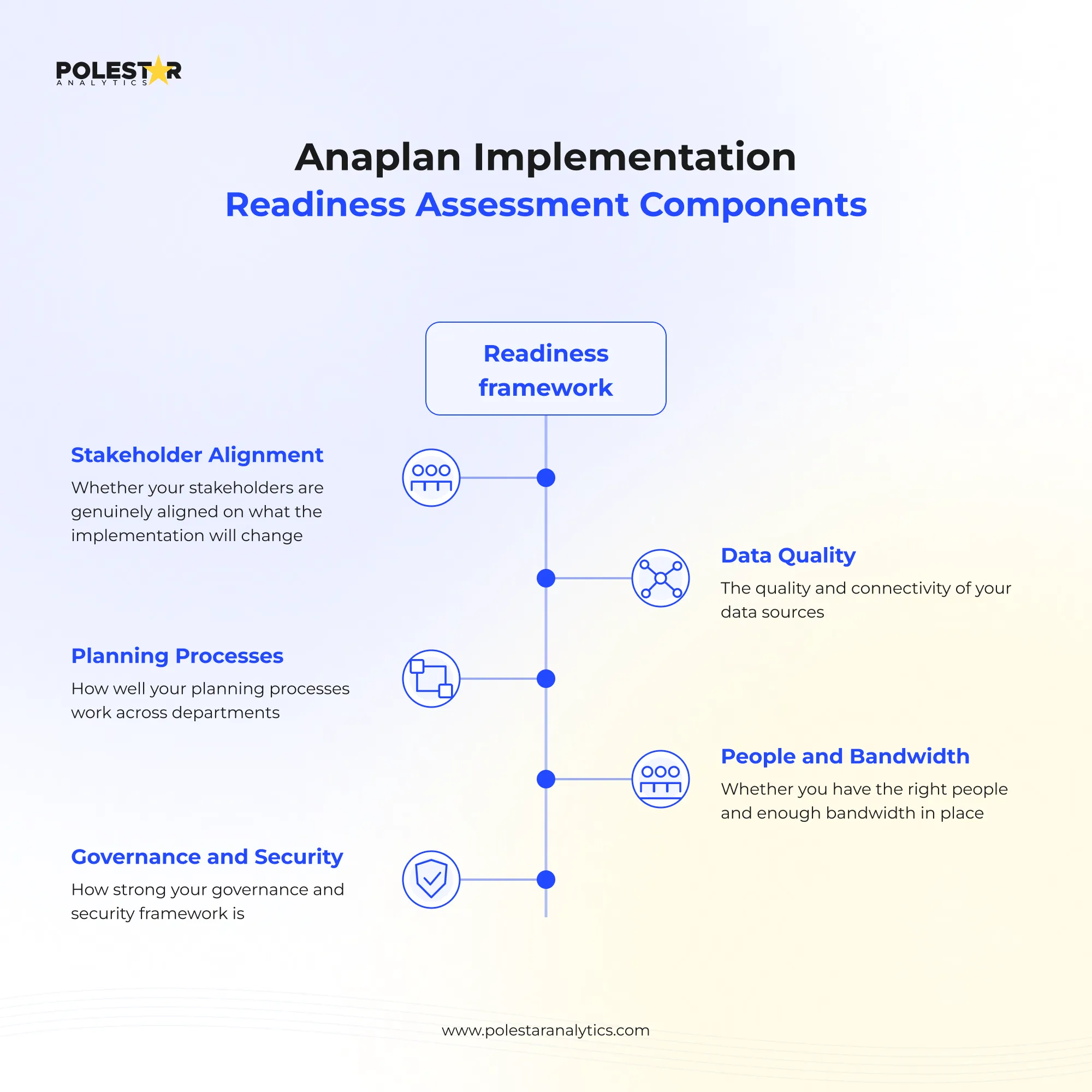
Let us understand what each of these means.
All Anaplan models draw their information from your source systems: ERP, CRM, HRIS, and more. Should these systems deliver inconsistent, outdated, or cobbled-together data, all of the forecasts and scenarios built upon this data inherit the problem.
What the assessment evaluates: Whether your source systems deliver clean, timely data. Whether automated integration pipelines exist or teams are still exporting CSVs and reconciling manually. And which data silos need to connect before Anaplan can act as your single source of truth. IBM's Institute for Business Value found that 43 percent of COOs name data quality as their most pressing data management challenge, which gives you a sense of how common this gap is.
Anaplan connects planning across departments. But when Finance follows its own forecasting approach, Supply Chain follows a different approach, and Sales has a third approach, it is not the connection but rather the disconnect that poses problems.
This is where most readiness gaps go undetected. Gartner research cited across 2026 industry analyses found that 84% of employees experience "collaboration drag" when working across functions, which is the friction of misaligned handoffs, duplicate work, and conflicting definitions. Anaplan does not remove that friction on its own. If it exists in the current process, it gets encoded into the model. The assessment evaluates the extent to which your planning processes are compatible for working in unison or destined for collision once connected.
What the assessment evaluates: How planning workflows operate across departments today. Where manual handoffs, duplicate steps, or misaligned timelines create friction. Whether teams share common metric definitions or operate with conflicting ones. And whether current processes can adapt to a cloud-based planning model, where workflows like emailing spreadsheets back and forth are replaced by shared workspaces and live dashboards.
Find out where your data, process, and resource gaps sit before they become implementation blockers.
Scope Your Anaplan Readiness AssessmentAn Anaplan implementation needs people, time, and the right skill sets. That includes someone who owns the model logic, someone who manages the workspace, and functional leads from each department who can validate outputs against real business scenarios. It also means having enough bandwidth across the team so the implementation does not stall every time a planning cycle or reporting deadline comes around.
What the assessment evaluates: Whether the right roles are identified: model builders, workspace administrators, and business process owners. Whether those people have enough capacity to support the implementation alongside their regular responsibilities. And whether there is clear ownership for reviewing and validating outputs, especially for AI-assisted capabilities like Anaplan Co-Modeler. Gartner's research on talent trends for 2026 warns that by 2030, half of enterprises will face irreversible skill shortages in critical roles, which makes early capacity planning even more important.
One of Anaplan's key differentiators is that it puts full control in the hands of the business user. This is an important strength, but if there are not guardrails in place, it can mean that any user who has access can make changes to logic, overwriting inputs or creating competing model versions. If this happens on a large scale, across many business units, you will be back where you started without a single source of truth. IBM's Cost of a Data Breach research places the global average breach cost near USD 4.9 million as of 2026, with misconfigured access controls consistently among the top contributing factors. Governance is not a compliance checkbox; it is the difference between a controlled planning environment and an expensive incident.
What the assessment evaluates: If role-based access controls are in place to ensure that the right individuals have the correct amount of access. If data governance policies are in place to manage input into the platform. Finally, if IT is engaged early enough to handle the requirements around security, compliance, and integration. Avoiding the engagement of IT is the number one shortcut and is almost always a mistake.
Anaplan shifts the ways teams plan, work together, and make decisions. Prosci's change management benchmarking research, reflected across 2026 industry reporting, shows that projects with strong change management achieve an 88% success rate, while those with poor change management succeed only 12% of the time. The platform is rarely the deciding factor.
However, if stakeholders (those who will be using the tool) do not know the rationale behind its adoption, what is going to change for them and what they can expect to see as a result, adoption will stall even if models are built perfectly.
What the assessment evaluates: Is there a business case for implementation which stakeholders in all departments believe in? Do users of the tool know what is going to change in their day-to-day work? Is the timeline of implementation aligned with the reality in terms of organizational processes of planning, leadership approvals, training period, etc.? And finally, is there an adoption strategy after go-live, as it is the hardest part of the process: not building the models but getting people to use them?
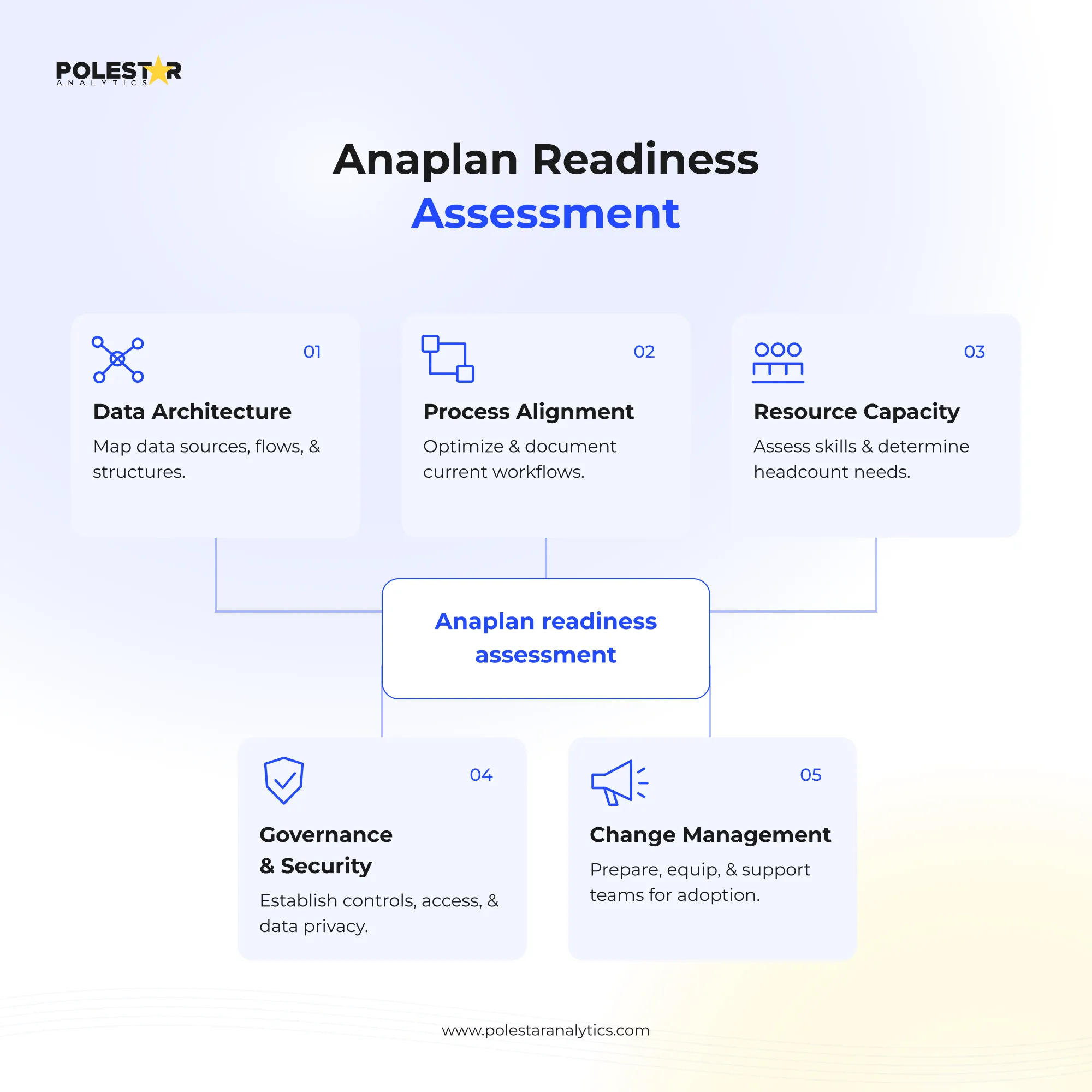
| Readiness Domain | What to Evaluate | Red Flag If... |
|---|---|---|
| Data Architecture & Quality | Source system reliability, integration pipelines, data silos | Teams still reconcile data manually via emailed spreadsheets |
| Process Alignment | Cross-functional workflows, metric definitions, planning cadence | Planning processes or metric definitions are unclear or inconsistent across teams |
| Resource Capacity | Role identification, team capacity, output ownership | No clear ownership exists for reviewing and validating model outputs or Co-Modeler recommendations |
| Governance & Security | Role-based access, data policies, IT involvement | IT has not been briefed on the implementation scope or timeline |
| Change Management | Stakeholder communication, business case clarity, adoption plan | No quantified value proposition exists beyond "we need a better tool" |
If a couple of those rows sound a little too familiar, you're not alone. Most enterprises flag at least one on their first pass. Here's how Polestar Analytics helps close those gaps.
A readiness assessment is only useful if it ends with something your team can act on. Here's what you walk away with:
So instead of a generic checklist, you get a clear picture of where you stand and what to do next, before any budget goes into model building.
The strength of an Anaplan deployment depends greatly on the foundation on which it is built. If the data is unorganized, processes are isolated, resources are strained, or everyone in charge does not have their ducks in a row regarding the purposes of the platform, there will be nothing that can save you once the models are built.
This is precisely what a readiness assessment uncovers before it becomes an expensive mistake. A readiness assessment gives you a full idea of your status and the way forward.
Polestar Analytics is an Anaplan implementation partner that assists companies in doing everything correctly from the start. As one of the largest Anaplan delivery organizations across APAC and the United States, Polestar Analytics works with finance and supply chain teams on everything from readiness assessments and architecture design to scalable, AI-powered connected planning solutions. They are also a preferred partner for Anaplan Co-Modeler and Anaplan Agent Studio, helping enterprises move past AI experiments into real adoption.
Whether you are scoping your first deployment or expanding into new planning domains, start with a readiness assessment that covers all five areas.
Talk to Polestar Analytics' Anaplan TeamAn Anaplan readiness assessment evaluates data and integration readiness, planning processes, resource capacity, governance, and stakeholder alignment. It identifies gaps that could affect implementation scope, timelines, model reliability, and user adoption.
Prepare your current planning workflows, source-system landscape, existing models and spreadsheets, implementation objectives, stakeholder list, and known pain points. These inputs help the assessment identify dependencies and prioritize improvement areas.
The assessment should translate findings into a clear view of readiness gaps, implementation dependencies, and recommended next steps. Depending on the assessment scope, this may include prioritized remediation actions and inputs for implementation planning. Confirm the specific deliverables with the assessment provider.
The duration depends on the number of planning domains, source systems, stakeholder groups, and the complexity of the existing environment. Confirm the expected timeline and stakeholder involvement with your implementation partner before the assessment begins.
No. The assessment should help distinguish critical dependencies that need to be addressed before model development from improvements that can be handled in parallel or in later phases. The priorities depend on your implementation scope, risks, and business objectives.
Over de auteur
The weems of data
In data, as in chess, the real power lies in foresight.
Gerelateerde blog
 Kshitij Gupta