 Kshitij GuptaData Strategist

Meld u aan om de nieuwste inzichten en updates over technologie, AI & data-analyse, datawetenschap en innovaties van Polestar Analytics te ontvangen.
 Vat dit blogbericht samen met:
| Databricks migrations fail when re-engineering hides as a data move: proprietary SQL, undocumented stored procedures, orchestration, and untested edge cases a lift-and-shift skips over. |
TL;DR
Here is the thing nobody tells you upfront: a Databricks migration almost never falls apart because of data volume. It falls apart because the team treated a re-engineering job like a copy-paste. The damage tends to land in four familiar spots. Proprietary SQL dialects translate with subtle logic errors. Business rules nobody documented sit buried inside stored procedures. Legacy orchestration has to be rebuilt from scratch. And the lift-and-shift trap quietly drags every old inefficiency into the new house.
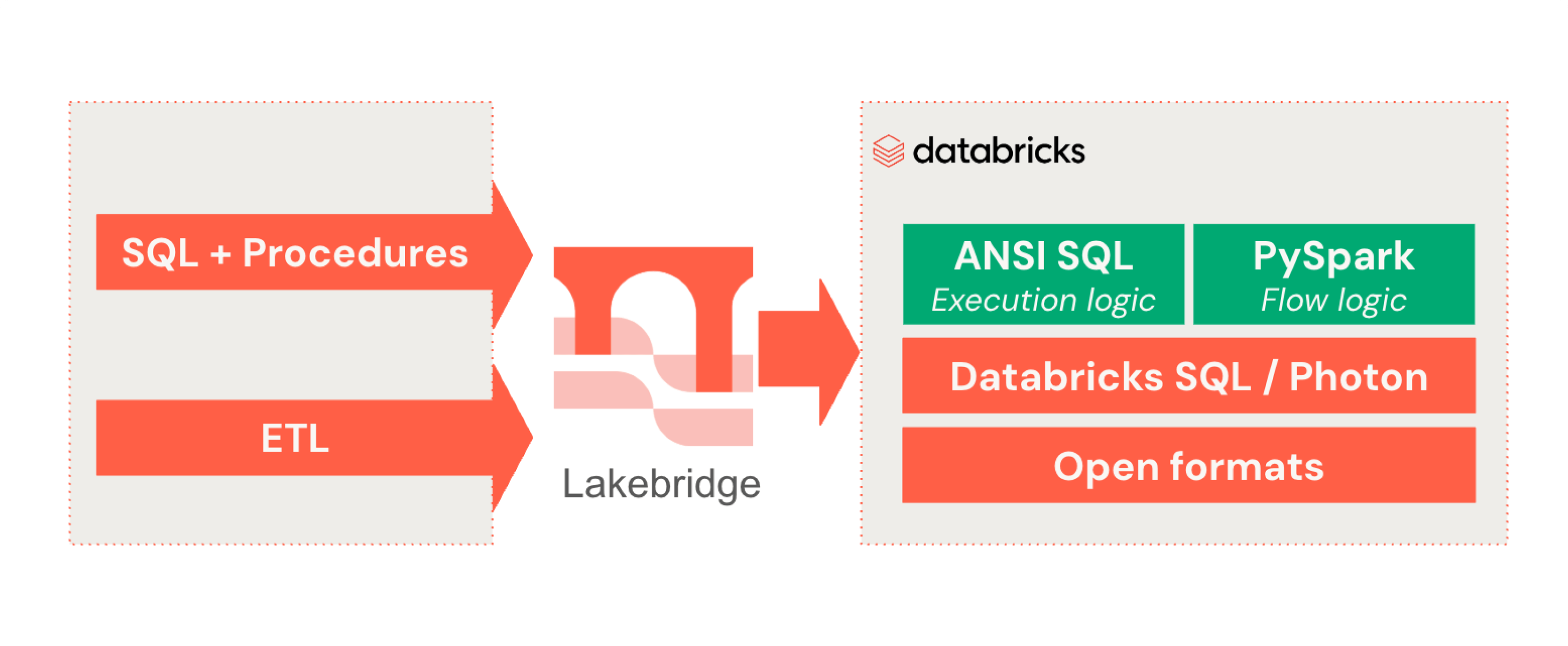
The teams that actually finish on time do a few things differently. They sort every workload into move, modernize, or retire before touching a single table. They run the full assessment phase instead of rushing it. They validate all of their data rather than spot-checking a sample. They bring experienced help in early, and they govern through Unity Catalog from day one. Technologies like Databricks Lakebridge and the recently-released SQL Stored Procedures reduce the amount of manual work considerably, but the results of a project still depend on proper sequencing and execution. We present this Databricks migration guide, explaining what parts of the migration can fail and how to avoid failures.
Picture the moment a migration goes sideways. The tables copied over fine, the row counts matched, everyone exhaled. Then a finance report that had run clean for a decade came back with a number that was quietly, unmistakably wrong. Nobody touched the logic. Except somebody had, the moment a stored procedure written in a dialect that no longer exists got translated a little too literally.
This is the part teams keep underestimating, and the stakes are not small. According to S&P Global Market Intelligence's survey, organizations abandon 46% of their AI proof-of-concepts before they ever reach production, and the share of companies scrapping most of their AI initiatives leapt from 17% to 42% in a single year. Put that in budget terms and it gets uncomfortable fast. Migrations routinely run $500K to $3M, and the overruns stack on top of that. A Databricks migration is absolutely worth doing. It is also worth knowing, before you start, exactly where the floor tends to give way first.
The cause of the problem is often a misdiagnosis. Most teams approach migration as a lift-and-shift exercise when it is actually a re-engineering project disguised as a data move.
Timeframes vary widely. A data warehouse under 500GB can take around two to four months, and an enterprise migration with challenging legacy dependencies can take anywhere from six months to a year and a half. What blows out those numbers is rarely raw data volume. It is data quality, downstream dependencies, and custom transformation logic. Quality problems on their own are a frequent culprit. In Precisely's data integrity report, 64% of organizations named data quality their top data integrity challenge, and 67% said they do not fully trust their own data for decision-making, up from 55% a year earlier.
Then there is downtime, which is what turns a slipped deadline into something the whole business feels. An outage during cutover, in a data-dependent operation, is not an inconvenience. It is a revenue problem with a timestamp on it. These are the Databricks migration challenges that do not show up on the project plan until they are already costing you.
So where does a data warehouse migration to Databricks actually go wrong? Four places, mostly, and they show up in roughly the same order every time.
Proprietary SQL dialects. Your old warehouse uses a different language than Databricks. Teradata's BTEQ, T-SQL from Microsoft, PL/SQL from Oracle, has to become ANSI-compliant SQL. As Databricks explains, it converts proprietary dialects such as BTEQ (Teradata), T-SQL (Microsoft), or PL/SQL (Oracle) into ANSI-compliant SQL suitable to run in Databricks SQL. This is where subtle logic errors can arise, as a comma or a peculiarity of NULL handling that was meaningful in the previous dialect may have a different meaning in the new dialect.
Undocumented business rules. The riskiest code is the code nobody remembers writing. One migration framework puts it well: the business rules buried in stored procedures are the riskiest part, so assess them early, not during cutover. Scope a Teradata estate and you can turn up hundreds of jobs and thousands of SQL scripts piled up over years. Every one of them is a small unknown.
Orchestration and scheduling. Legacy schedulers do not travel for free. Every job, dependency, and trigger gets rebuilt, usually on Databricks Workflows, which steps in as native orchestration to replace legacy schedulers, coordinating notebooks, SQL, pipelines, and ML in one place.
The lift-and-shift trap. Copying the warehouse verbatim feels safe and is the single most expensive mistake on the menu. A pure lift-and-shift carries forward the old inefficiencies and misses the entire point of moving. You pay full price to migrate and inherit every problem you were trying to leave behind.
See how the Databricks Lakehouse solves core data engineering challenges.
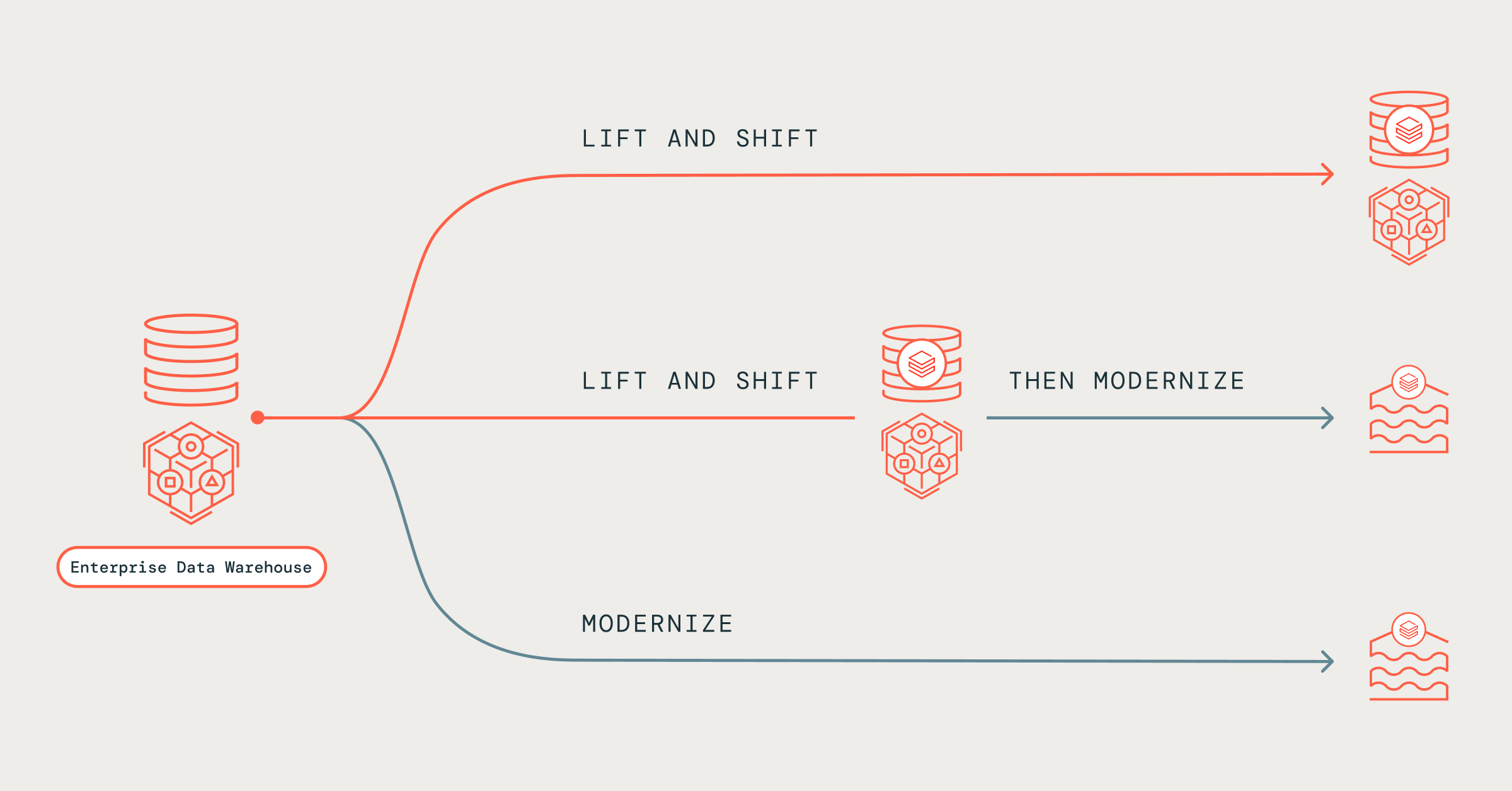
Discover the LakehouseDo not try to move everything the same way. That is the mistake at the heart of most failed projects. Some workloads can travel more or less as they are. Others need a rethink on the way over. Several workloads should just be turned off without any further action, given that they haven't been used in any way for two years and are not going to be missed. Databricks adopts this principle in its own Databricks migration framework, migrating some workloads mostly identically and modernizing or changing others, while completely cutting off the rest. The specific sorting of each workload into one category or another is the core of the Databricks migration strategy.
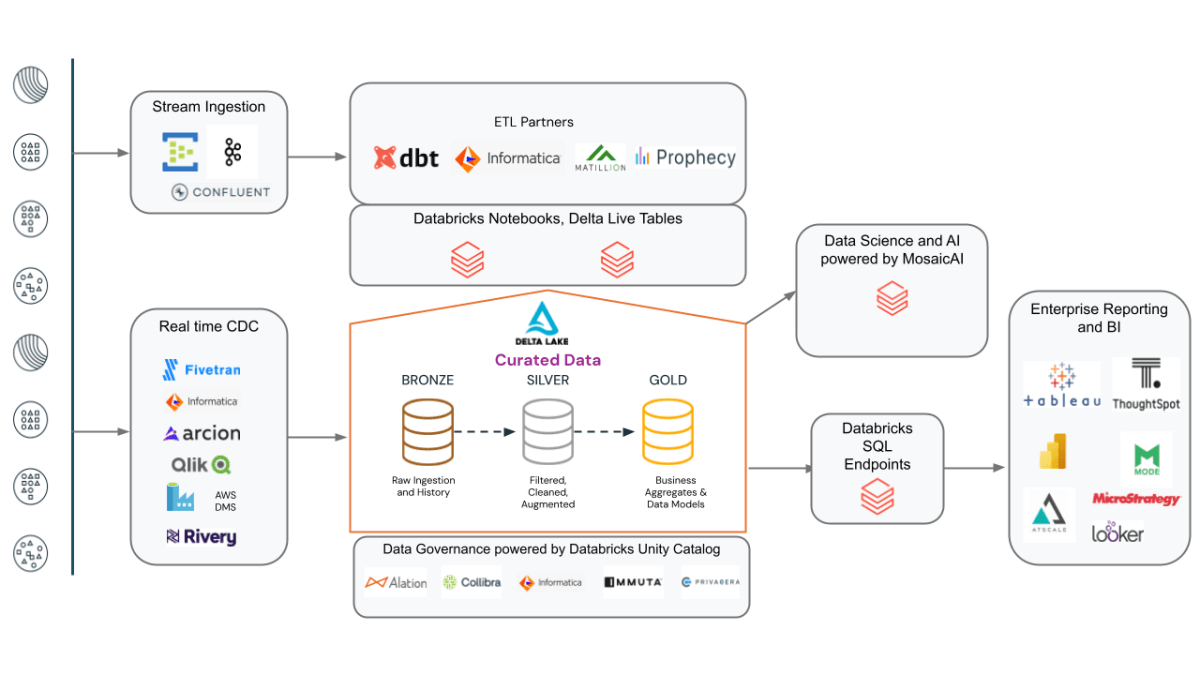
The sequence you run those buckets in matters too, arguably more than whatever tool you pick. Databricks lays it out in phases: discovery and assessment first, then architecture design, then the data warehouse itself, then stored procedures and ETL, then BI and analytics, with validation closing it out. People are always tempted to shortcut the assessment phase to claw back a few weeks. Those weeks come back with interest at cutover, right when the undocumented logic decides to reveal itself. Good Databricks migration planning treats assessment as the phase you cannot afford to rush.
See our strategic guide to Databricks data platform implementation.
Databricks Implementation GuideFor the manual grind in the middle, there is Lakebridge, a free Databricks migration tool built out of the BladeBridge acquisition. It comes in three parts. An Analyzer scans metadata and legacy code to inventory tables, views, ETL jobs, and stored procedures, then ranks them by complexity. A Converter handles the SQL translation. A Validator reconciles the results afterward. Databricks says Lakebridge can automate up to 80% of the migration process and roughly double implementation speed, across migrations from more than 10 systems including Teradata, Snowflake, and SQL Server. Treat the exact figures as vendor numbers, but the direction is right.
Databricks has incorporated SQL Stored Procedures, which is now publicly accessible. This means that most of your procedure logic can be migrated without needing a complete rewrite. Polestar Analytics approaches this stage with MigrationStudio, part of its 1Platform. Rather than translating code line by line, its agents scan the source estate, flag jobs nobody runs anymore, and are designed to rebuild each workload as clean, native target code, so the old inefficiencies don't make the trip.
A few practices make the difference between teams that can finish their projects on time and those that cannot, and they are all rather uncomplicated practices.
Validate as you proceed. Most migration failures are testing failures in disguise. The old habit of spot-checking a sample of under 1% of data, instead of validating 100% of it, is exactly how silent errors survive all the way into production. Compare schemas, row counts, and aggregates across the old and new systems on every workload, every run. It feels slow. It is far slower to unwind a bad number after the business has already acted on it.
Get expertise in early, and not as a box-ticking formality. Consulting analyses keep landing on the same finding: experienced guidance is the single biggest factor separating successful migrations from expensive disasters, ahead of platform choice. Databricks runs a network of Certified Migration Partners for precisely this stage.
Govern from day one. Land everything in Unity Catalog from the start and lineage, access control, and auditability come baked in rather than bolted on later. That is what keeps the new warehouse trustworthy once you finally power the old one down. It is also one of the quieter Databricks migration best practices that pays off long after cutover.
As a Databricks partner, Polestar Analytics pairs migration engineering with domain teams across CPG, retail, pharma and financial services, so someone who understands the business reads the rules buried in those stored procedures before they're converted.
Here is where it all nets out. Migrating to Databricks fails not because the platform cannot support your data, but because the migration was re-engineering disguised as moving data. The proprietary SQL, the undocumented procedures, the orchestration and the untested edge cases are exactly what a lift-and-shift does not consider. Assess early, move selectively, validate everything, and a failed migration simply stops being your story. Treat it as a copy job, and it almost certainly becomes one.
It depends far more on dependency complexity than on data size. A small warehouse can land in a couple of months, while a tangled enterprise estate with heavy custom logic can run past a year.
Sort workloads into move, modernize, or retire before touching a table, then sequence discovery and assessment first. The Databricks migration services and Certified Migration Partners exist for exactly the stages where in-house experience runs thin.
Definitely for analysis and business intelligence, and increasingly for the logic that previously locked teams into legacy systems. The important thing about running a data warehouse on Databricks is that you have to redesign it, rather than replicate the old one.
Over de auteur
Data Strategist
Most data answers questions. The right data changes direction.
Gerelateerde blog
 Aishwarya Saran