For much of the past decade, the DTC and CPG e-commerce growth playbook followed a simple logic: spend on acquisition, grow revenue, raise more, and spend again.
The metrics looked healthy. Net sales were up. Active customer counts climbed. New customer volumes created the appearance of scale.
But beneath that growth, a structural weakness was building.
For brands reporting strong revenue growth, the danger lies in what the top line hides. They are not always building loyal customer bases. In many cases, they are replacing customers faster, spending more to do it, and calling it scale.
The risk is that acquisition-fuelled growth can hide a retention crisis for years. Strong revenue performance delays the harder questions:
- How much of last year's revenue came from customers who are unlikely to buy again?
- And what is the real lifetime value of a customer, not the optimistic version built into the model?
- How much discount spend is buying sales that would have happened anyway?
The Acquisition Trap
When you look at it, Customer acquisition cost (CAC) has risen approximately 60% over the past five years, driven by iOS privacy changes that degraded targeting precision, rising CPMs across Meta and Google, and intensifying competition for the same digital shelf space. Meanwhile, the average DTC e-commerce retention rate sits between 25-30%, meaning brands must replace 70-75% of their active customer base every year just to stand still. It's safe to say that the mathematics of this model are punishing.
New customers cost more to win than existing customers cost to keep.
Retained customers usually spend more, need less convincing, and are more likely to recommend the brand. Yet most e-commerce analytics budgets still go into acquisition attribution, while retention intelligence gets treated as a secondary layer.
Signs you have a hidden retention crisis
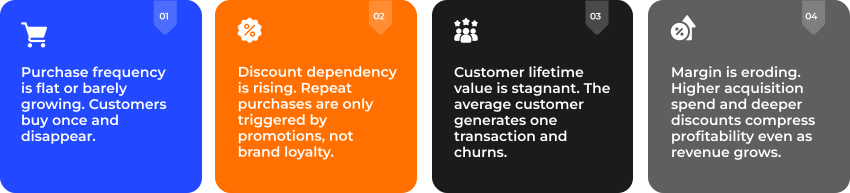
The issue is simple: the brands spending the most to acquire customers often have the least clarity on how to retain them. And as CAC climbs, the margin available to absorb each new customer's payback period shrinks. Without a Customer Value Management layer and churn analytics that systematically identifies and activates latent value in the existing base, brands find themselves in a permanent sprint — faster and faster on a treadmill that generates less and less return per dollar spent.
The 2026 Inflection Point
The organizations hence run into these three major structural shifts that make this problem more urgent and more solvable:
| Shift |
What changed |
Impact |
CVM opportunity |
| Privacy and signal loss |
ATT, consent rules, browser-level tracking limits, and fragmented identity signals |
Paid media targeting and attribution get less reliable |
First-party customer data becomes a strategic asset |
| AI-enabled personalization |
LLMs and automation make segment-to-message workflows faster |
Customer expectations rise |
CVM activation becomes more practical |
| Margin pressure |
Inflation, discounting, and paid media competition tighten P&L room |
Growth quality matters more |
Retention ROI becomes measurable |
| Data stack maturity |
Cloud warehouses, dbt, Databricks, BI, and AI layers now work together |
Analytics refresh cycles shrink |
CVM shifts from quarterly analysis to an operating model |
Why Customer Value Management Is the Answer and Why 2026 Changes the Equation
Customer Value Management is not a new concept. What has changed decisively in the last 24 months is the infrastructure available to execute it on a scale, the speed at which insights can be activated, and the cost of not doing so in a market where first-party data is increasingly the only reliable moat.
At its core, CVM is the practice of understanding, measuring, and systematically maximising the value of each customer across their full lifecycle with the brand-from first purchase through advocacy. It is not a technology platform. It is not a single analytics project. It is an operating model that replaces blunt, acquisition-oriented marketing with precision, retention-oriented customer management built on the data the brand already owns. As a customer value management strategy, it connects customer lifetime management, customer lifetime value management, and retention execution across the business.
customer value management answers four questions that most e-commerce analytics functions cannot currently answer with confidence:
- Who are my highest-value customers and am I at risk of losing them?
- Which customers are about to churn and what intervention has the highest ROI?
- What does each customer segment actually need and am I communicating accordingly?
- Is my discount spend driving incremental revenue or buying sales I would have made anyway?
Until recently, building a Customer Value Management capability required a large central analytics team, a 3-6-month data engineering project, and a significant BI investment. Insights were batch-generated, segment refreshes ran monthly at best, and the gap between insight and campaign activation was measured in weeks.
However, three platform shifts have collapsed that timeline:
| Capability |
What it enables |
| Unified data layer |
A governed customer view across transactions, product, returns, discounts, campaigns, service, and acquisition source |
| Machine learning at scale |
Segmentation, churn scoring, product affinity, next-best-product, and promotion incrementality on scheduled pipelines |
| AI activation |
Campaign briefs, offer logic, next-best-actions, and executive summaries generated from governed model outputs |
| Business governance |
A cadence where segment movements, churn spikes, promo leakage, and win-back opportunity reach the teams that own action |
That is the real shift CVM brings.
Once customer data, ML, AI activation, and governance start working together, the business is no longer looking at customers as one broad base. It starts seeing where value is building, where it is leaking, and which customer groups need action first.
This is where segmentation becomes important.
Not as a static marketing label, but as the structure that turns CVM insight into practical decisions across retention, win-back, cross-sell, discount control, and customer growth.
Customer Segmentation: The Decision Layer Inside CVM and AI Customer Segmentation
Most brands already segment customers in some form.
The issue is that those segments often describe the customer but do not guide the decision.
High value. Active. Lapsed. Dormant. Loyal.
Useful labels, but not enough.
A CVM-led segmentation model should go further. It should tell the business what to do next, for whom, when, and with what commercial logic. Modern AI for customer segmentation works best when customer segmentation AI is governed by clear value, lifecycle, and margin logic.
| Segmentation lens |
Best Use |
Example question |
| RFM segmentation |
Quick view of customer value and engagement |
Who bought recently, buys often, and spends more? |
| Lifecycle segmentation |
CRM journey design |
Who is new, active, lapsing, dormant, or reactivated? |
| Need-based clustering |
Message and product relevance |
What problem or use case is the customer buying for? |
| Product affinity segmentation |
Cross-sell, bundles, assortment |
Which categories naturally travel together? |
| Profitability segmentation |
Margin protection |
Which customers create profitable growth after discounts and service costs? |
| Channel & referral segmentation |
Media and acquisition planning |
Which acquisition sources create better retained value? |
| Predictive segmentation |
Churn prevention and next-best-action |
Who is likely to churn, upgrade, buy again, or respond to an offer? |
| Occasion or mission segmentation |
Retail, CPG, BFSI contextual activation |
What purchase mission, life event, or intent signal should shape outreach? |
The strength of CVM comes from the intersection of these lenses.
AI based customer segmentation and customer segmentation using AI can then translate those intersections into AI customer segments that marketing, CRM, and category teams can actually use. Customer Value Management processes should support this logic, not replace it.
For example, a high-value customer who has not purchased in 250 days needs a different intervention from a low-frequency customer who only responds to discounts. Both may appear “at risk,” but the next best action should not be the same.
This is why Polestar Analytics does not treat segmentation as the end output. Because the power of strong approach is the intersection of all lenses. A micro-segment matrix — four value tiers crossed with five need profiles — produces 20 distinct customer groups, each with its own behavioral signature, product affinity, and optimal intervention strategy. That is the architecture for precision at scale.
| Value segment |
Description |
Priority |
Sample tactic |
| Brand Advocates |
High recency, frequency, and monetary value |
Protect and amplify |
Loyalty privileges, early access, referral rewards |
| Engaged Stars |
Recent, frequent, high spend |
Upsell and grow |
Category expansion, cross-sell to adjacent needs |
| Engaged Potentials |
Active, but spending and basket width can grow |
Increase basket width |
Adjacent category coupons, samples, bundles |
| Infrequent Potentials |
Large base, lower engagement |
Drive frequency |
Need-based content, refill prompts, targeted offers |
This is where CVM becomes more than segmentation. It becomes a way to make customer decisions repeatable. Because the goal is not more segments. The goal is fewer wasted actions. A segment matters only when it changes the decision you take.
The Polestar Analytics' Customer Value Management Intelligence Framework: Five Phases to a Live Operating Model
Polestar Analytics' CVM Intelligence Framework is designed to move brands from raw customer data to a live operating model for retention, win-back, personalization, and profitable growth.
Each phase builds on the previous one. Each produces measurable value before the next begins.
| Phase |
Core work |
Output |
| 1. Data Foundation |
Ingest and unify transactions, customer master, product master, discounts, returns, channel, and
campaign data. Resolve customer identity, product hierarchy, promotional tags, and refresh rules.
|
A governed customer data layer that downstream analytics trusts. |
| 2. Business Diagnostics |
Assess sales performance, new vs. returning mix, churn, frequency, category affinity, discount
performance, promo ROI, and acquisition-source LTV. |
A KPI scorecard and prioritized issue map. |
| 3. Advanced Analytics |
Build RFM, need-based clusters, churn propensity, product affinity, basket opportunity, win-back
logic, and promotion incrementality models. |
Addressable customer micro-segments with tactical playbooks. |
| 4. AI Activation |
Translate segment intelligence into campaign briefs, offer logic, next-best-actions, automated
alerts, and executive summaries. |
A decision engine that helps business teams act faster. |
| 5. Governance and Adoption |
Define owners, intervention rules, measurement design, approval workflows, test-control standards,
and refresh cadence. |
A CVM operating rhythm that survives beyond the first report. |
Make your existing stack work harder for customer value.
Move faster from customer insight to action, without rebuilding your tech stack.
The framework matters only when it changes what the business can see and act on.
In a real CVM diagnostic, these phases helped reveal what top-line growth was hiding: high churn, misallocated discount spend, invisible micro-segments, and recoverable revenue already sitting inside the customer base.
Here is how that played out for a leading DTC beauty and personal care brand.
Proof of Concept : A Leading Beauty Brand Diagnostic
When we partnered with a leading DTC beauty and personal care brand operating ~26,000 active customers for improving their CVM diagnostic, following findings came through :
Diagnostic Metrics at a Glance
+34%
Active customers, YoY
1.32x
Average purchase frequency
Finding 1: Growth Was Real. The Retention Crisis Was Hidden.
Year-over-year, net sales grew 35% and the active customer base grew 34% — metrics that signal a healthy, scaling business. The underlying cohort analysis told a fundamentally different story. Of the approximately 19,700 customers active in Year 1, only 3,377 made a purchase in Year 2. The effective churn rate was 83%. Sales growth was being powered almost entirely by new customer acquisition — an expensive, unsustainable mechanism that was quietly compressing margins while the top line climbed. With customer churn AI, the brand could predict churn earlier and prioritize interventions before the customer fully lapsed.
Finding 2: Discount Spend Was Systematically Misallocated.
The diagnostic decomposed promotional spend by customer activity type and found that 61% of total discount budget was being applied to new customer acquisition, 36% to retention, and just 2.8% to win-back of churned customers. Two further findings amplified the concern: discount peaks coincided with event-driven sales peaks — particularly Christmas — suggesting that peak-season discounting was amplifying demand that would have materialised anyway. And in more recent periods, organic sales growth had actually accelerated as discount rates declined, signalling underlying brand strength that the discounting strategy was suppressing rather than building.
| Activity Type |
Share of Discount Budget |
Strategic Assessment |
| Acquisition of new customers |
61% |
Disproportionately high given 83% churn rate |
| Retention of existing customers |
36% |
Under-invested relative to LTV of retained customers |
| Win-back of churned customers |
2.8% |
Severely under-resourced; highest potential ROI cohort |
Finding 3: 20 Addressable Micro-Segments Were Invisible to Marketing.
Layering RFM segmentation with need-based clustering produced a 4×5 micro-segment matrix: four value tiers crossed with five need profiles. Each cell represented a distinct customer group with different behavioural signals, different product affinities, and — critically — different optimal intervention strategies. Instead of one email blast to 26,000 customers, the brand now had the architecture for 20 targeted communications — each matched to what that customer actually needs, at the moment they are most likely to act.
Finding 4: $635,000 in Recoverable Revenue Was Sitting Unaddressed.
Crossing value segments with recency buckets produced a prioritised win-back and retention roadmap with quantified revenue impact:
| Priority |
Target Cohort |
Est. Revenue Impact |
| Win-Back Priority 1 |
Brand Advocates + Engaged Stars lapsed 301-550 days |
~$113,836 |
| Win-Back Priority 2 |
Engaged Potentials lapsed 301-730 days |
Incremental |
| Proactive Retention |
All segments showing 201-300 day inactivity |
~$522,099 at risk |
The combined at-risk and recoverable revenue identified in a single diagnostic — from two years of transaction data — exceeded $635,000. None of it required acquiring a single new customer. All of it was already in the database, waiting for an analytical layer capable of seeing it.
How Customer Value Management works across Industries
The beauty and personal care diagnostic shows one application of CVM. The same operating logic applies wherever customer relationships, product portfolios, margins, and retention matter. The execution changes by industry. The decision logic stays consistent. The data signals, segmentation frameworks, and activation mechanisms apply wherever there are recurring customer relationships and transaction data to analyse.
Though the execution changes by industry. The decision logic stays consistent.
| Industry |
CVM use cases |
Capability required |
| CPG |
Trade promotion effectiveness, replenishment behavior, retail media audiences, loyalty-linked
category growth, and basket expansion |
RGM logic, promo analytics, demand signals, customer and product hierarchy design, Power BI or
Tableau reporting, and AI-assisted activation |
| Retail and eCommerce |
Repeat purchase, win-back, loyalty, personalized offers, category affinity, markdown leakage,
discount leakage, and cohort health |
Customer diagnostics, segmentation, churn scoring, promotion incrementality, eCommerce data
engineering, and CRM-ready action lists |
| BFSI |
Next-best-product, relationship deepening, attrition risk, dormant customer reactivation, channel
migration, household value |
Data governance, explainable segmentation, regulated analytics delivery, portfolio-level customer
value modeling |
Across industries, CVM should answer the same commercial question: Which customer action creates the most profitable next unit of growth?
The Modern Customer Value Management Technology Stack
Once the business use cases are clear, the next question is whether the organization has the architecture to support them. CVM does not need another disconnected tool. It needs a governed stack where customer data, analytics, AI, BI, and activation systems work as one decision layer.
A modern CVM capability should be scalable, governed, and close to business action. It should also work around the client's existing ecosystem wherever possible.
| Layer |
Example tools |
Role in CVM |
| Data ingestion and storage |
Snowflake, Databricks, cloud storage |
Unifies customer, order, product, promotion, return, and campaign data |
| Transformation and governance |
dbt, data quality rules, metadata documentation |
Turns raw exports into tested, auditable, analytics-ready data models |
| Advanced analytics and ML |
Databricks ML, Python |
Runs segmentation, churn propensity, product affinity, and incrementality models |
| AI activation |
Claude API, governed LLM workflows |
Converts model outputs into campaign briefs, summaries, offer logic, and next-best-action
recommendations |
| Rapid prototyping |
Replit and lightweight apps |
Surfaces insights to CRM, marketing, category, and commercial users without long engineering cycles
|
| Visualization and delivery |
Power BI, Tableau, Qlik |
Gives teams self-serve visibility into customer health, segments, promo ROI, and churn risk |
| Campaign activation |
CRM, CDP, marketing automation platforms |
Moves segments and triggers into owned-channel execution |
The design principle is ownership. The client should own the data, the logic, the models, the documentation, and the decision cadence.
This is a delivery partner like Polestar Analytics' brings the techno-functional depth needed to build, operationalize, and transfer the capability without creating a black box.
Customer Value Management as a Service: Building an Operating Model, Not Another Report
The most common failure mode in analytics engagements is the 'report and forget' dynamic: a project produces valuable insights that gather dust because no one owns the implementation, the data becomes stale, and the momentum dissipates. Business teams move back to broad campaigns and manual reporting. Polestar Analytics' CVMaaS model is designed specifically to prevent this. A service-led CVM operating model solves this by keeping analytics, model refresh, business review, and action governance on a recurring rhythm.
The Monthly Rhythm
| Week |
Deliverable |
Content |
Audience |
| Week 1 |
Customer Base Health Report |
Segment composition, churn movement, frequency trends, retention risk |
VP CRM / Business Head |
| Week 2 |
Promotion Performance Debrief |
Campaign lift, baseline comparison, incrementality, discount ROI |
CMO / Category Head |
| Week 3 |
Product Intelligence Brief |
Affinity signals, bundle opportunity, cannibalization alerts |
VP eCommerce / Merchandising |
| Week 4 |
Executive CVM Scorecard |
Health dashboard, segment-level actions, next month priorities |
CDO / CIO / Business Head |
Escalation and Anomaly Detection
Beyond the monthly rhythm, CVMaaS model should flag decision points: churn spikes in high-value segments, promotion underperformance against incrementality thresholds, sudden discount dependency, product launch cannibalization, and changes in acquisition-source quality.
The AI Activation Layer in Practice
When the model identifies a cohort — such as 765 haircare-focused infrequent potentials with 180 days of inactivity — the AI layer generates a campaign brief, offer recommendation, subject-line variants, and performance hypotheses. Analysts still validate the output. The business receives a faster path from signal to action.
The goal is not to remove the analyst. The goal is to expand analyst capacity and give business teams faster access to customer decisions.
Customer Value Management Engagement Model and Next Steps
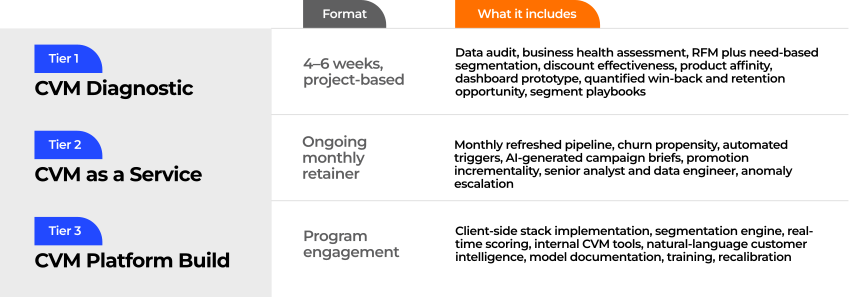
Polestar Analytics' engagement model is designed on a Land and Expand principle: start with a time-boxed, high-value diagnostic that demonstrates ROI, then scale into a managed service and, where appropriate, a platform build.
What Data Is Needed to Start
- Transaction data: 12-24 months of order-level data with order ID, customer ID, product, quantity, price, discount, and date
- Product master: SKU, category, price tier, product family, new vs. existing flag
- Customer master: customer ID, acquisition source, channel, geography, loyalty tier, consent fields
What to Look for in a Customer Value Management Partner
CVM is not a project a brand finishes once. It is an operating capability that needs to be built, run, and eventually owned. The partner you choose for it should be evaluated less on tooling slides and more on whether the engagement leaves the business with a working capability — or another dependency.
Five questions worth asking any partner before a CVM engagement begins:
1. Do they start with the business question, or the dataset?
The strongest CVM work begins with KPI hierarchy, category logic, customer lifecycle, margin, and CAC payback — before the data is touched. Teams that lead with tools and dashboards tend to produce analytics that look impressive in a steerco but rarely change a business decision.
2. Can one team carry it from data plumbing to business adoption?
CVM breaks when data engineering, BI, ML, AI activation, CRM integration, and measurement design sit in different teams that hand off to each other. The business question, the model, and the activation channel need to stay connected. A techno-functional partner — one team across the full stack — is structurally better suited to this than a stitched-together set of specialists.
3. How is AI being used, and who owns the logic?
AI is genuinely useful in CVM for accelerating briefs, summaries, offer logic, and next-best-action recommendations. But the segment definitions, business context, and measurement design should sit with experienced consultants — not be hidden inside a model. Ask where governance sits before you ask how fast the AI is.
4. Can they speak credibly to every buyer in the room?
A CVM program touches the CDO who needs data governance, the CIO who needs architecture fit, the VP CRM who needs actions, and the business head who needs P&L impact. A partner that can hold all four conversations — without translation losses — moves a program forward materially faster.
5. Does the engagement end with the client owning the capability?
The most important test. After the diagnostic, the managed rhythm, or the platform build, does the client own the data, the models, the documentation, and the decision cadence? Or do they own an SLA with the vendor? A CVM partner should be designing themselves out of the critical path, not into it.
This is where partner capability becomes critical. The right CVM partner should bring domain depth, full-stack execution, practical AI, and the ability to translate customer intelligence into business action.
The framework defines how CVM moves from data to action. The final question is what kind of delivery capability is needed to make that operating model repeatable, governed, and owned by the business.
Where Polestar Analytics Fits in the Customer Value Management Journey
The final question is capability.
CVM does not work when strategy, data engineering, analytics, AI, and business adoption sit in separate tracks. It works when one connected team can take the business question from raw data to governed action.
That is where partner capability becomes critical.
| Polestar Analytics’ Differentiator |
What It Means in Practice |
| Domain-first, not data-first |
A strong CVM partner should think in KPI hierarchies, category management frameworks, CRM priorities, and eCommerce operating models before opening a dataset. Every engagement should be led by consultants who understand retail and CPG analytics programs, not data teams applying generic models to a retail context. |
| Full-stack capability |
The right partner should own the full journey, from raw transaction data and cloud pipelines to ML models, AI integrations, and Tableau or Power BI dashboards. One team should connect the data layer, intelligence layer, and activation layer without fragmented handoffs. |
| AI that earns its place |
AI should amplify analyst output, not replace business judgment. Every model output should be validated through domain context before it reaches the client team. The goal is usable, explainable AI, not black-box outputs that the business cannot act on. |
| Built for enterprise buyer complexit |
A CVM partner should understand the stakeholder landscape: the CDO who needs platform ROI justification, the VP CRM who needs campaign lift evidence, and the business head who needs P&L impact. The work should translate clearly across all three audiences. |
This is the lens Polestar Analytics brings to CVM Intelligence: domain-first thinking, full-stack delivery, practical AI, and stakeholder-ready execution.
Because the real opportunity in CVM is not more reporting. It is finding the next dollar of growth inside the customers you already have.