
Summarize this blog post with:
| Inventory is cash that has left the business but not yet returned. Every extra day of DIO lengthens the cash conversion cycle and traps liquidity, so early detection beats quarter-end reaction. |
TL;DR
Inventory is quietly draining enterprise cash flow. PwC (2026) reports EU days inventory outstanding has surged 19.3% since 2015, pushing net working capital days to a ten-year high, and static monthly reports cannot manage that pressure. This piece unpacks why inventory is 2026's hardest working capital lever, what modern working capital analytics does with inventory data, and how Polestar Analytics' CapitalPulse, an agentic AI-native working capital intelligence platform, closes the loop from live signal to executed cash action.
Most finance teams can move receivables and payables with a few deliberate calls. Inventory resists that kind of correction: it sits at the intersection of procurement lead times, demand forecasts, supplier reliability, and shelf life, and responds slowly to management pressure.
The numbers come from PwC's Working Capital Study 25/26, analyzing 17,000+ companies: EU net working capital days at a ten-year high, driven by that 19.3% DIO surge. Inventory, not receivables, was the primary driver of the deterioration.
Deloitte's 2026 outlook adds a warning about how the recent gains were won. Across 2,300+ companies, its Working Capital Roundup found that there was a reduction of about 0.9 days per year of the cash conversion cycle, relying on tactical actions regarding inventory and accounts payable instead of structural action. Its message is clear: resilience in 2026 will come through integrating working capital into the operations process.
The takeaway is uncomfortable: the inventory number can look stable while the underlying discipline erodes. You need the drivers, not just the metric.
Traditional inventory reporting answers what happened. A working capital analytics platform answers three harder questions: what is shifting, why, and what to do about it.
Descriptive reporting tells you DIO rose from 32 to 39 days: late and undirected. Working capital analytics connects that rise to specific drivers, an advance payment on a delayed order, a supplier lead time stretched from 10 to 18 weeks, a cluster of SKUs at stockout risk, and quantifies the cash impact of each, then lets you simulate the fix before committing capital.
That is the leap from inventory optimization software inside the supply chain function to working capital management software that treats inventory as one lever inside a single liquidity equation:
CCC = DIO + DSO − DPO
Cutting stock to lower DIO can trigger stockouts that push customers to net-60 terms, raising DSO. A genuine working capital optimization solution holds all three levers in view at once, which is why inventory analytics has become inseparable from finance; the operational foundations are covered in this guide to inventory analytics best practices.
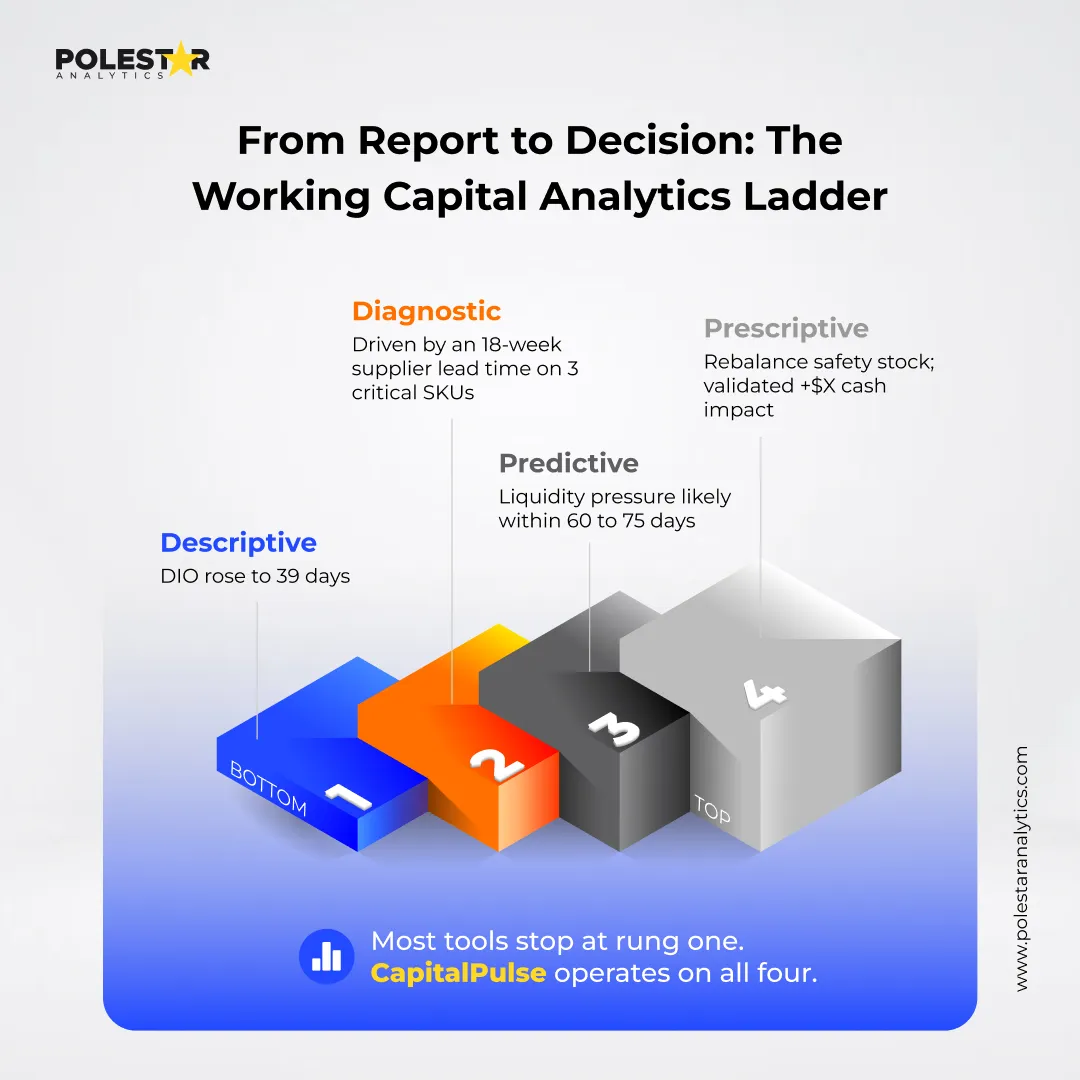
Understanding what working capital analytics should do is one thing; standing up the operating layer that actually does it in a live enterprise is another. Inventory, receivables, and payables data sit in different systems on different refresh cycles. Root-cause analysis takes days. Every scenario decision has to be re-validated in the planning model, and every action needs an owner, a deadline, and an audit trail. That is the gap an intelligence platform has to close.
This is where CapitalPulse comes in. Polestar Analytics' CapitalPulse is an agentic AI-native working capital intelligence platform built for the CFO office. Before the workflow itself, five capabilities set it apart from dashboard-style tools.
CapitalPulse: capabilities at a glance
- Real-time signal monitoring across AR, AP, inventory, and cash flow, on a single command center.
- AI-powered root-cause analysis that translates fragmented signals into a plain-language diagnosis with a quantified cash impact.
- Scenario simulation with an Anaplan Bridge that validates every projection against live enterprise cash-flow models.
- Execution agents that convert approved actions into owner-assigned, deadline-bound tasks with a full audit trail.
- An anti-recommendation engine that flags what NOT to do, guarding margin and service levels.
CapitalPulse organizes the workflow into three tightly linked stages. Each stage runs on the live command center; a screenshot below every stage grounds it in the actual product.
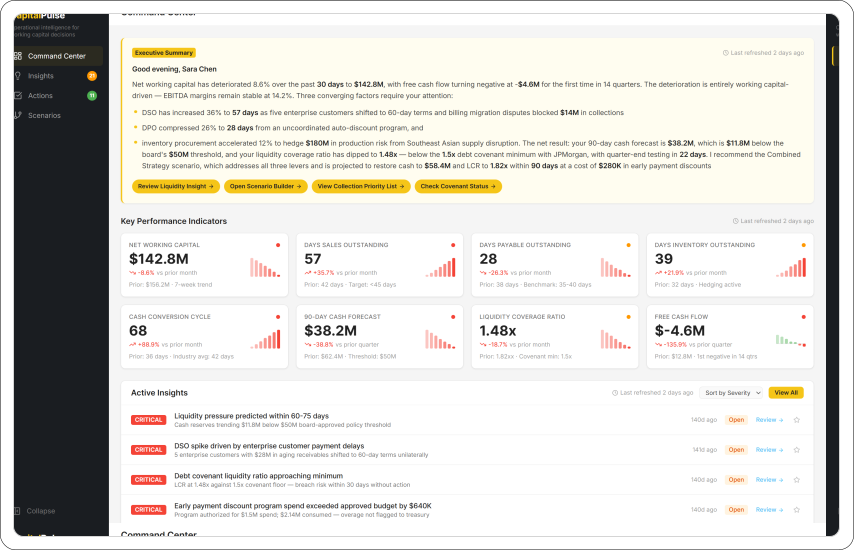
- Live signals monitored across receivables, payables, inventory, and cash flow.
- Machine learning across the full dataset, not static thresholds, catches velocity slowdowns, trapped value, and lead-time extensions on production-critical SKUs.
- Every inventory event is read in a cash context: an order backed by an advance payment surfaces as a forecasted dent in free cash flow.
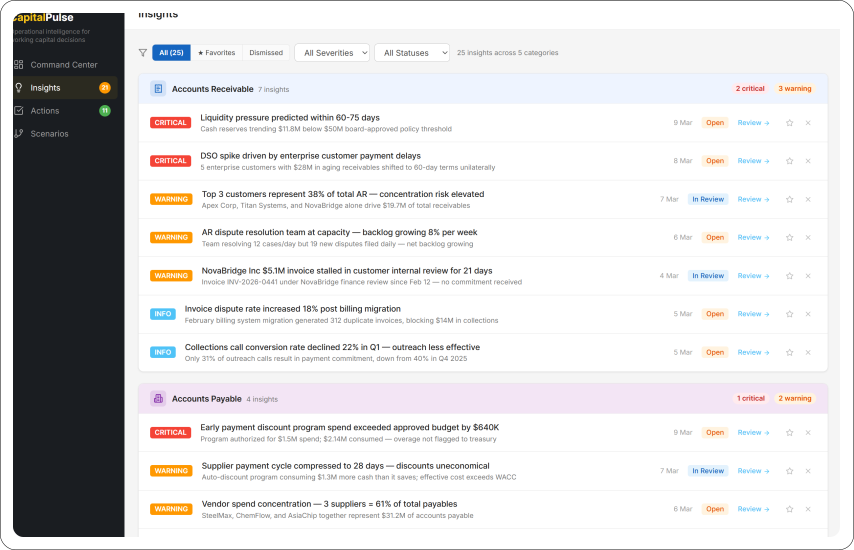
- Plain-language root-cause narrative correlates vendors, customers, and stock signals and quantifies the financial impact.
- No more days spent stitching SAP inventory, Ariba/Coupa payables, and receivables aging; the platform delivers a decision-ready diagnosis.
- Supplier concentration risk factored in automatically. The discipline behind slow-moving and high-value stock is detailed in this work on inventory aging analysis.
- Scenario builder models inventory targets, DPO, and early-payment discounts side by side, with 90-day cash impact projected in real time.
- Through the Anaplan Bridge, each scenario is validated against live enterprise cash-flow and liquidity models, not a spreadsheet guess. Polestar Analytics is an established Anaplan partner, so the split is deliberate: CapitalPulse supplies the operational drivers; Anaplan performs the detailed forecasting.
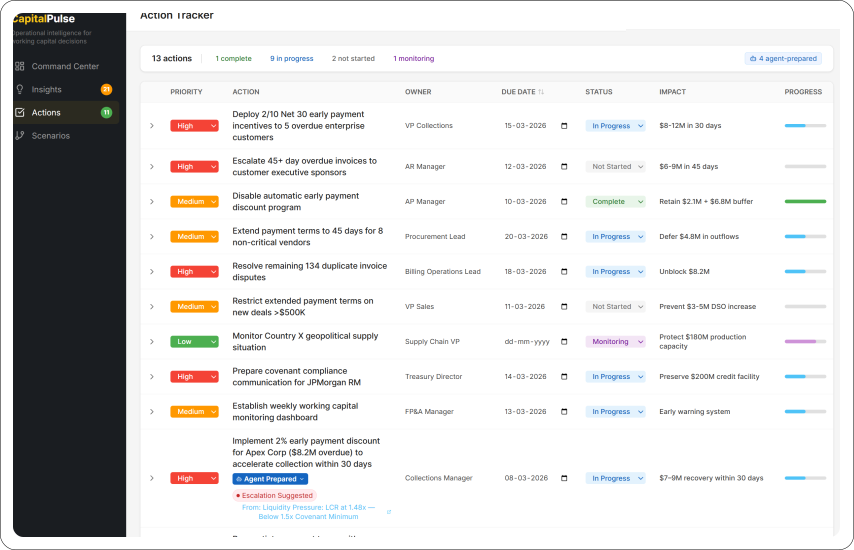
- Execution agents draft vendor and customer communications, assign owners, set deadlines, and route everything to an action tracker with full traceability.
- Benchmark: decision cycles compressed from weeks to hours, freeing analyst teams by 20+ hours a week.
"The failure mode in inventory management is not a lack of data; it is the lag between the signal and the action. AI-native working capital analytics compresses that lag from weeks to hours and, just as importantly, tells you what not to do."
- Watch the CapitalPulse Product Demo

Inventory will remain the hardest working capital lever to move in 2026, and the enterprises that pull ahead will not be the ones with more dashboards. They will be the ones that treat inventory as a live cash decision, connecting demand, supply, and liquidity in a single governed workflow. That is the core value AI-powered inventory optimization now offers finance and supply chain leaders, and it is exactly the operating model CapitalPulse brings to the CFO office.
Improving cash flow through inventory optimization at enterprise scale requires three things at once: live detection of inventory risk, governed AI inventory optimization that explains itself, and execution that closes the loop. When those three come together, and are validated against a top-down model such as Anaplan for Anaplan-driven supply chain planning, inventory stops being a source of cash surprises and becomes a working capital lever the CFO can actually pull.
It shifts inventory from lagging reports to live decisions: detect anomalies, diagnose the cash impact, simulate the fix before acting. CapitalPulse does this across receivables, payables, and inventory together, so every inventory decision is weighed against the full cash conversion cycle.
Run the cross-lever test first: simulate the change and check downstream DSO and stockout effects before committing. CapitalPulse projects the 90-day cash impact and validates it via the Anaplan Bridge, showing whether a DIO cut genuinely releases cash or just shifts the problem.
Inventory optimization software typically lives inside the supply chain function and optimizes stock against demand and service targets. Working capital management solutions treat inventory as one lever inside the liquidity equation, connecting it to payables, receivables, and cash flow. CapitalPulse is the latter: it interprets inventory movements as cash events and routes them into a finance-owned workflow.
Certainly, when the AI is being governed. CapitalPulse integrates ML with an adjustable signal architecture, enabling each organisation to define their own thresholds for alerts, and providing an entire audit history for all insights and actions, offering AI's speed along with the governance it demands.
Yes. Enterprise data is fragmented across ERPs, AP systems, and spreadsheets. CapitalPulse ingests from a consolidated gold layer where available and supports structured templates elsewhere, so working capital optimization starts without a lengthy data-cleansing prerequisite.
- Inventory is the 2026 pressure point. PwC attributes the EU's ten-year-high working capital days largely to a 19.3% surge in DIO; the problem is structural, not seasonal.
- The metric is not the point; the drivers are. Working capital analytics explains why DIO shifts and quantifies the cash at stake, in hours rather than weeks.
- Optimize inventory as part of the cash equation. Isolated inventory cuts can worsen the cash conversion cycle. CapitalPulse holds DIO, DSO, and DPO in one view.
- Close the loop. Detection and diagnosis pay off only when paired with simulation, validation, and tracked execution.
- Governed AI beats black-box AI. Configurable thresholds plus a complete audit trail make the intelligence trustworthy for treasury and the board.
Ready to turn inventory into a live cash lever?