
Summarize this blog post with:
| An Annual Operating Plan (AOP) is a one-year financial and operational blueprint that translates strategy into revenue, expense, headcount, and KPI targets, aligning teams and guiding execution. |
TL;DR
An Annual Operating Plan (AOP) translates long-term strategy into a practical one-year roadmap, aligning revenue, expenses, headcount, investments, operational targets, and KPIs. It brings together top-down strategic goals and bottom-up business inputs to create realistic plans. This guide breaks down what an AOP is, how it differs from a budget and forecast, its key components, the step-by-step planning process, and common challenges. It also explores best practices for building an AOP that is collaborative, data-driven, scenario-ready, and adaptable to changing business conditions.
An Annual Operating Plan (AOP) is a 12-month financial and operational plan that translates a company's long-term strategy into specific, measurable targets for revenue, expenses, headcount, investments, and operating KPIs. It is the document finance leaders use to decide how much the business will spend, sell, hire, and invest in the coming year, and how each function will contribute to those numbers.
Is it something significant, or just another buzzword that's here to complicate an already tangled function like finance that has stringent external as well as internal norms and guidelines that it needs to follow?
The best way to understand it would be by comparing it to planning of a road trip. If you plan a road trip across the country, would you simply hop into your car and start driving?
Of course not. You would plan your stops, estimate the time you expect to reach each destination, make an estimate of your expenses, etc.
Similarly, without an Annual Operating Plan (AOP), an organization can set as many goals as it likes but it will be shooting in the dark when the time comes for execution. So, what exactly is an Annual Operating Plan and why is it needed?
The Annual Operating Plan is an essential practice that involves creating a detailed blueprint that highlights the company's financial goals for the next year or even longer. To achieve these goals, it sets the revenue, expense, and profit targets. It also aligns people across departments and provides a guide on how the company should operate in the short term to achieve its long-term objectives.
One of the most common questions finance leaders ask is how the annual operating plan differs from a budget, forecast, or strategic plan. In practice, these four are related but distinct instruments.
The AOP sits in the middle, connecting long-term strategy with day-to-day execution. The table below summarizes AOP vs budget, AOP vs forecast, and annual operating plan vs strategic plan across the parameters that matter most to finance teams.
| Parameters |
Annual Operating Plan (AOP) |
Budget |
Forecast |
Strategic Plan |
| Time Horizon |
1 year, broken into quarters and months |
1 year, fixed |
Rolling, updated monthly or quarterly |
3 to 5 years or longer |
| Primary focus |
Aligns strategy with operational execution |
Cost control and spend authorization |
Predicting likely outcomes based on latest data |
Long-term vision positioning, growth |
| Level of detail |
High: revenue, expenses, headcount, KPIs, initiatives |
High on financial line items |
Moderate, focused on key drivers |
Low, directional |
| Flexibility |
Reviewed quarterly, adjustable via scenarios |
Rigid once approved |
Highly flexible |
Rarely changed |
| Ownership |
CFO, FP&A, department heads |
Finance and budget owners |
FP&A team |
CEO, board, executive team |
| Output |
Actionable plan with targets, KPIs, and accountability |
Approved spending limits |
Updated view of where the business is heading |
Long-term roadmap |
So, the strategic plan sets the destination, the annual operating plan plots the year's route, the budget authorizes the spend, and the forecast tells you whether you are still on track.
A well-structured annual operating plan should include the following annual operating plan components. Each one plays a specific role in turning strategy into a plan finance and business teams can actually execute.
- Revenue Plan: It lays out expected sales by product, channel, customer segment, and geography. It is built from pricing assumptions, volume forecasts, and pipeline data, and is usually the anchor number the rest of the AOP is built around.
- Expense Plan: This covers Cost of Goods Sold (COGS), Selling, General & Administrative expenses (SG&A), and any function-specific operating costs. Expenses should be tied back to the revenue plan and to operational drivers such as units produced, headcount, or square footage.
- Headcount and Workforce Plan: Headcount is one of the largest cost lines for most organizations. The AOP should include a role-level view of hires, backfills, attrition, and compensation changes, linked to the initiatives each team is expected to deliver.
- Investments: Capex and R&D: Machinery, technology, facilities, product development are planned here. Each investment should have a business case, an expected payback, and a link to a strategic initiative.
- Operational Targets: Beyond financial numbers, the AOP includes operational targets such as units produced, utilization rate, scrap rate, on-time delivery, customer retention, and service levels. These are the drivers behind the financials.
- Planning Assumptions: Every AOP rests on a set of assumptions: inflation rate, FX rates, wage inflation, commodity prices, market growth, win rates, and churn. Documenting these assumptions makes it easy to explain variances later and to rerun scenarios when conditions change.
- KPIs and Accountability: To measure and track the progress of your goals, Annual Operating Plan (AOP) key performance indicators (KPIs) are essential. Each department will have its own set of KPIs, such as for Sales it could be Cost of Goods Sold, Day Sales Outstanding, Net Promoter Score, etc.
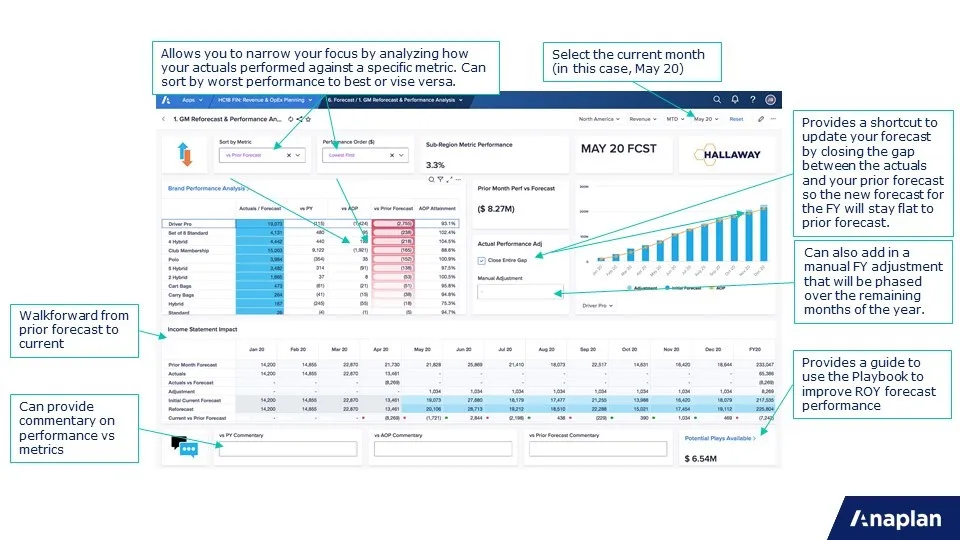 Performance can be monitored easily with the AOP platform
- Risk and Scenario Plans: Anticipating risk can help organization proactively respond to any potential issues that can affect the planned process. You can utilize scenario analysis for testing different outcomes and adjust strategies in advance for a smoother execution of the AOP in Finance.
Now that we know the key components/features of the AOP, you might be finding it a daunting task to create the AOP. Rest assured, in the next section we will guide you through the steps to create your own Annual Operating Plan (AOP) that will systematically integrate all the necessary components.
Reach your Financial planning goals, be it Financial planning or Financial analytics, we have got you covered.
The annual operating plan process is where most organizations either build alignment or lose it. The annual operating plan steps below give finance teams a clear sequence, from kickoff to monitoring.
1. Kick Off and Align Stakeholders
This involves the official launch of AOP development by gathering key stakeholders from various departments like finance, operations, sales, HR, and any other critical business areas. While the financial team acts as the gatekeeper for the Annual Operating Plan, cross-functional collaboration is essential to make a robust AOP. At this stage, you should take your time to set specific roles and responsibilities: finance leaders may be responsible for setting budgetary parameters, department heads for identifying key initiatives, project managers for coordinating the entire process, and so on.
2. Review Strategy and Set Planning Assumptions
Before any numbers are set, revisit the long-range plan and lock the planning assumptions (inflation, FX, wage growth, market growth, pricing). Documenting these upfront prevents endless rework later and keeps every function planning off the same baseline.
3. Map the End-to-End Workflow
Next, map out the current processes to help everyone understand how each step connects. These exercises give a more realistic picture of what can be achieved with the existing flow and highlight the inefficiencies that need to be addressed.
4. Forecasting
- Top-Down Target Setting
To establish an overarching financial target for the organization, you will need to review the company's Long-Range Planning (LRP). It involves the forecasts considering a macro-economic point of view. With this, you can set targets (Revenue growth, SG&A growth, Capex growth, etc.) based on historical performance, overall market conditions, and growth opportunities. Though, ensure that these targets align with the company's vision and operational capabilities. These insights form the foundation of the annual operating plan (AOP) for organizations, supported further by bottom-up inputs to ensure realistic and achievable goals.
But hold on! The top-down view is only half the story. Get inputs from the people on the ground, your sub-regions, which can provide a more micro-economic level realistic view of the business. Hence, after overall targets are set, they are communicated to the stakeholders at sub-regions.
Build a systematic annual operating plan (AOP) framework to collect their intel like sales forecast, operational insights and resources needed, consumer expectations, local market trends, and any historical data related to a specific region, etc. These considerations help you refine the overall quality of your AOP finance, making it realistic and achievable. These inputs can be quantitative as well as qualitative in nature.
- Compare
Comparing top-down and bottom-up approaches helps in identifying the variance between the expectations of the two levels. With this perspective, determine if a discrepancy is acceptable or requires intervention.
5. Set Sales and Production Goals
After gathering input from different levels, it all boils down to setting the sales and production goals.
- Sales: How much can you realistically sell? Using the market, competition and customer data, you can make an estimate of how much the demand would be.
- Production/Purchase Budget: Can you meet the demand? This considers the production or purchasing capabilities of the business. It considers the "hard" and "soft" capacity, operational efficiencies, etc.
6. Build the Detailed Budget
The sales and production budget goals determine the goals for other functions.
After the Sales goals have been fixed considering the production/purchasing capabilities, the next step involves defining the SG&A, Capex & R&D, COGS, and Inventory budget such that they can achieve the sales and production goals. This involves the following:
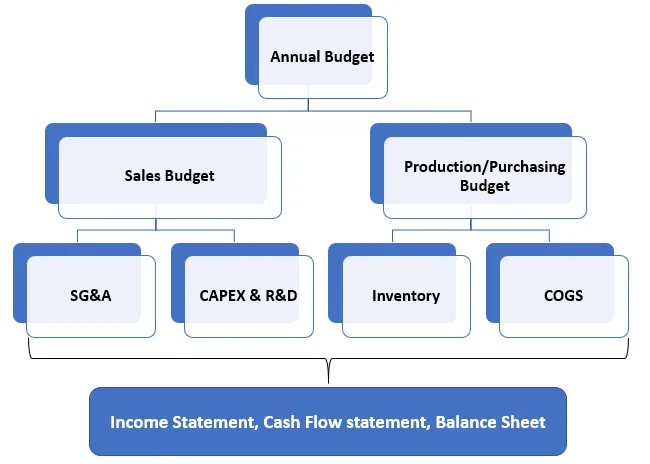 The sales and Production budget goals determine the goals for other functions
- Inventory: This budget determines the number of units that you are going to produce considering what you already have and the cost associated with the inventory. You will also be required to set KPIs like scrap rate, utilization rate, etc.
- Cost of Goods Sold (COGS): These are related to the direct cost associated with production. For example, these costs are direct labor, direct material, etc.
- Capex & R&D: These are costs associated with investment that are done for production. These are associated with machinery, building, repair and maintenance, etc.
- Selling, General & Administrative expenses: Allocate cost for aspects other than production. It can include sales and marketing cost, general administrative, customer services, etc.
7. Build the Playbook and Run Scenarios
After defining the budget, create a playbook that includes Annual Operating Plan best practices and strategies to guide the execution process. This also involves incorporating scenario analysis to evaluate different situations and the final outcome. These evaluations will improve the immunity of your AOP to the varying market conditions.
8. Finalize, Approve, and Communicate
In the final step, all the documents are assembled to create a comprehensive Annual Operating Plan. This document should include the finalized financial targets, detailed operating principles, resource allocations, and any strategic initiatives outlined in the playbook. After getting the green light from top management, distribute it amongst key stakeholders ensuring that everyone is clear about their role and responsibilities.
9. Execute, Monitor and Adjust
Once the AOP has been issued, the job is not complete. Keep an eye on the progress made and verify it aligns with the plan. And remember, the market today can be quite dynamic and so your AOP also needs to have the provision to incorporate required changes.
Now that you know how to create a structured AOP in finance, it is important to understand the various roadblocks that you might encounter. Like any new initiative, AOP can experience adoption challenges as it requires a shift from traditional, reactive planning to a more proactive and disciplined approach.
This can make stakeholders uncomfortable, who are skeptical of the new process. Implementation challenges can also surface, such as aligning cross-departmental goals, integrating various data sources, or deciding the necessary resources and buy-in from all levels of the organization. A detailed understanding of these challenges will better prepare you to tackle them effectively. In the next section let's explore these roadblocks and their potential remedies.
Discover our recent project: How an Anaplan solution revolutionized Financial Budgeting & Business Processes for a global pharma giant.
Across the AOP cycles we've seen, a handful of annual operating plan best practices separate the plans that guide the business from the ones that sit in a drawer.
- Collaboration over hand-offs: The AOP is not a finance-only exercise. Involve sales, operations, HR, and IT from day one so the plan reflects operational reality, not just financial ambition.
- Data accuracy and a single source of truth: Use a governed data layer or master data setup so every function is planning off the same numbers. Reconciliation debates should be about assumptions, not about whose spreadsheet is right.
- Scenario planning as a default, not an add-on: Always model at least an upside, base, and downside case. Know your triggers and the levers you will pull in each.
- Clear accountability at the KPI level: Every metric needs a named owner. Ownership is what turns a target into a result.
- Continuous monitoring, not annual reveal: Review actuals against plan monthly, refresh the forecast quarterly, and be willing to reopen the AOP mid-year if a core assumption breaks.
- Document your assumptions: When variances show up in month four, the team that wrote down its assumptions in month zero will explain them in minutes. The team that didn't will spend a week reconstructing them.
You probably might have already guessed some of the usual suspects when it comes to challenges related to the AOP: aligning top down and bottom up, setting realistic goals, adapting to market changes, etc. We will make sure to cover them; however, one of the biggest hurdles that we've experienced while working with globally established brands is data integration from different departments and systems. Here is a detailed section on this challenge.
a. Data Integration
Throughout the industry, it's a common practice for each department to use different file formats and data systems. This stems from the fact that each department often has to collect data from varying sources, internal as well as external. They have to deal with the different data formats and cloud services used by third party vendors, distributors, suppliers etc.
Maintaining separate data sets can lead to the creation of data silos, where each department manages its own data independently resulting in inconsistencies, lack of standardization, and difficulty in mapping and transforming data into a common format. Working with different data sources can also introduce security and compliance problems when integrating them.
What can be done?
- Utilize middleware solutions: They can act as a bridge between different applications, services, and systems within a distributed network. It simplifies the complexities of connecting different platforms by translating data formats, handling different communication protocols, and providing a common interface for disparate systems.
- Implement Application Programming Interfaces (APIs): You can also utilize well-defined APIs that are focused on enabling the communication between applications, making it easier to pull data from various sources.
- Implement Master Data Management (MDM): MDM is focused on creating a single authoritative source of truth for critical data. It helps you centralize your key data elements and reduce the inconsistencies in data arising from using multiple data sources. Also, our experience has shown that MDM 360 has proved to be a valuable solution for the various business problems we have encountered so far. Learn more about Master Data Management 360's capabilities and uses: 360° Clarity: Multidomain MDM for broader connectivity.
- Use a Long-Range Planning platform: Implementing an LRP platform can help centralize your insights from different departments, making it easier to plan and execute your Annual Operating Plan. These platforms support cross-functional collaboration, while providing the tools for scenario planning and analysis.
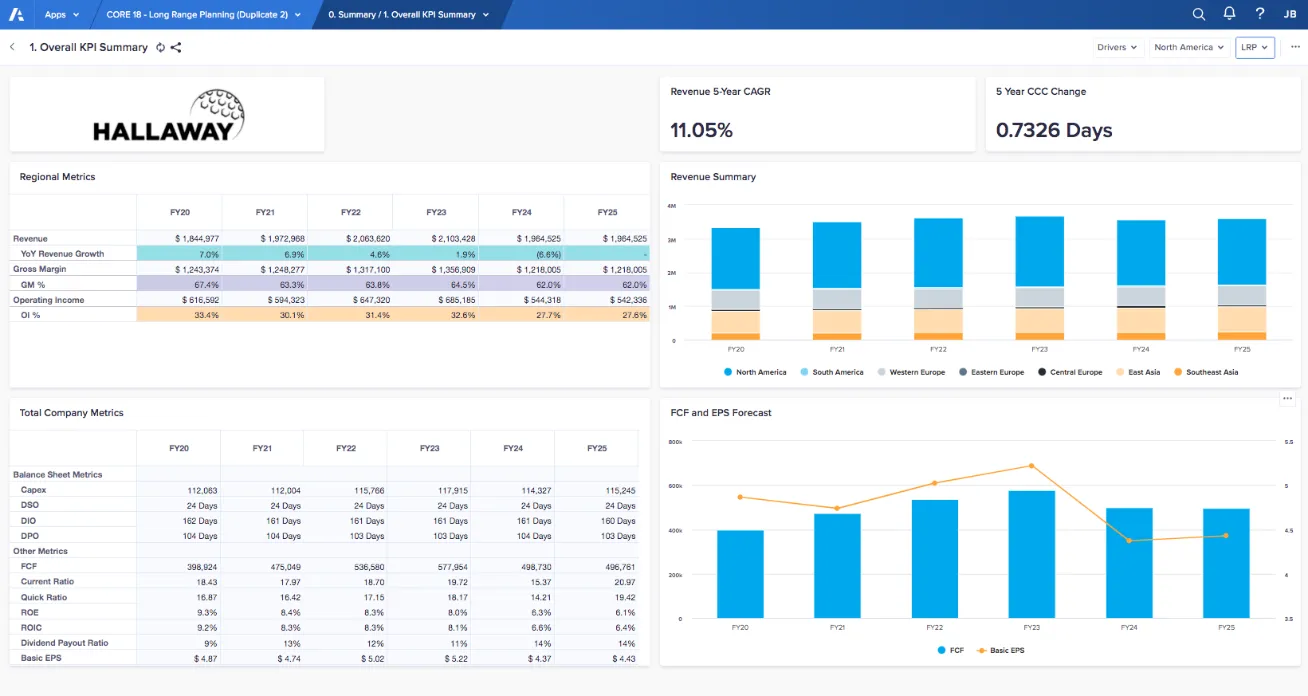 An LRP platform consolidates all the data in one place, making it easier to track the AOP process
b. Aligning top down and bottom up
The top-down approach usually sets a broader set of goals considering the macro factors without fully understanding the realities faced by the lower levels. Meanwhile, lower levels may be focused on fulfilling their operation requirements instead of aligning with overarching strategic objectives.
To deal with this, you will have to make sure to have a well-defined annual operating plan (AOP) framework that supports bi-directional decision-making.
c. Setting realistic goals
Another challenge is that the goals set at the top level might be unattainable for lower levels, which can demotivate teams and result in poor performance outcomes. Using data-driven goal setting can help mitigate the problem. Utilize historical data, market analysis and inputs to create SMART metrics to quantitatively measure performance.
d. Adapting to market changes
Rapidly changing market conditions or consumer preferences can make the Annual Operating Plan obsolete shortly after its creation. It might be difficult for teams to adapt to the changes quickly due to a rigid planning process.
We recommend adopting an agile approach with the scope to adapt to changing market conditions. This can include rolling forecasts and real-time data, while it is also a good practice to leave room for any necessary change using scenario planning.
Learn more about Master Data Management's multidomain connectivity capability, uses and get in touch with a field expert.
For leaders, an AOP is not just a planning document, it is a decision-making framework. It connects high-level strategy with operational execution by translating goals into measurable financial and business targets. With clearly defined KPIs, resource allocation, and scenario planning, leaders gain visibility into trade-offs, risks, and outcomes, enabling faster, data-backed decisions rather than relying on fragmented reports or delayed insights.
CFOs and finance leaders act as the orchestrators of the AOP. They ensure financial discipline, validate assumptions, and align business targets with economic realities. Beyond budgeting, their role is to create a single source of truth across functions, enforce accountability, and guide trade-off decisions. They also ensure that the AOP remains adaptable through scenario modeling and continuous performance tracking.
Alignment happens when leaders create a structured feedback loop between strategy and execution. While top management defines growth targets and priorities, inputs from regional and functional teams ensure realism. Leaders must enable a bi-directional planning process, supported by data and collaboration tools, where assumptions are continuously validated, variances are addressed early, and execution remains aligned with strategic intent.
Leaders should treat risk management in AOP as a proactive, continuous process rather than a one-time exercise. This includes identifying key financial and operational risks early, using scenario analysis to simulate different outcomes, and building contingency plans. A strong AOP allows leaders to understand the impact of disruptions, such as demand shifts or cost fluctuations, and take corrective actions before risks materialize.
An effective AOP is one that goes beyond static planning and enables execution. From a leadership standpoint, it should provide real-time visibility into performance, clearly defined ownership of initiatives, and the flexibility to adapt to changing market conditions. Most importantly, it should close the gap between planning and action, ensuring that strategic decisions are not just documented but consistently executed and measured.
In conclusion, the Annual Operating Plan (AOP) is more than just a document, it is a strategic tool that lays the foundation for achieving organizational goals by cascading the long-term objectives to short-term goals and action. By clearly defining objectives, allocating resources, and establishing measurable targets, an effective AOP aligns all team members toward common goals while providing an annual operating plan (AOP) framework for decision-making and performance evaluation.
Polestar Analytics is an Anaplan implementation partner that builds AI-enabled connected planning for finance and supply chain teams. We help organizations modernize AOP processes by connecting financial plans with operational drivers, enabling scenario planning, improving collaboration, and creating a more dynamic planning environment.