
Summarize this blog post with:
TL;DR; Wealth advisors aren’t underperforming - they’re operating inside fragmented data systems that consume up to 70% of their time on non-revenue tasks. The real issue isn’t effort or talent, but the lack of a unified data to outcomes architecture. WealthPulse solves this by acting as a Wealth Data Command Center - unifying multi-source data, unlocking cross-system KPIs, and delivering role-specific intelligence to advisors, operations, and leadership. The result: less manual work, faster decisions, earlier risk detection, and more time spent actually advising clients.
59% - that's how much of a relationship manager's working day, per 2025 Fidelity Advisor Insights Study, goes to tasks that generate zero revenue. Administration, compliance, and other non-client tasks, leaving many advisors feeling burned out or unable to grow. Add to that chasing down exceptions buried four tabs deep in a shared spreadsheet. Manually assembling the client picture that, in theory, already exists somewhere across the tech stack.
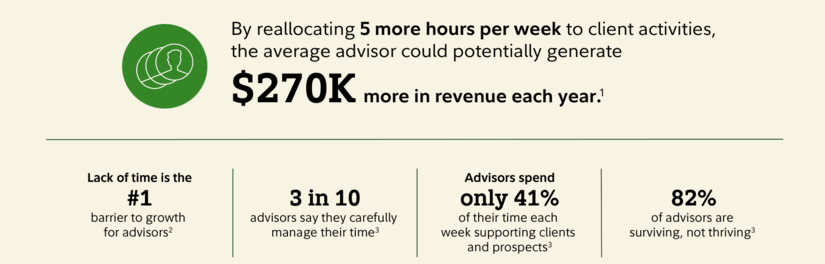 Source: Fidelity
Most firms have quietly absorbed this as just how wealth management works. And for a long time, the workaround was simple: hire more analysts, buy more tools, build better Excel models. But that math is breaking down. Smaller RIAs saw operating margins hit historic lows in 2024, with advisory expenses consuming up to 82% of revenue at some firms. You can't cost-cut your way to better intelligence.
The problem isn't effort. It's the underlying architecture - or rather, the absence of one.
This isn't just operationally painful. It creates a compounding chain of strategic blind spots:
- Advisors have no unified household view
- Leadership makes decisions on stale data
- IT Ops is always reactive
- Cross-source analytics are structurally impossible
And data silos have a documented revenue cost - industry analysis links fragmented data environments to 20–30% revenue in avoidable revenue leakage, from slow attrition signals, missed rebalancing windows, and the operational drag of doing manually what should run on autopilot.
The typical response to this? More point solutions. And yet nearly two-thirds of advisors still assemble their tech stack from several disconnected tools, even as almost half say they'd prefer one unified platform. The intent is there. The execution keeps falling short.
WealthPulse, our end-to-end wealth management system was built from a different premise. Not "how do we build a better reporting tool?" but "what does it look like when the entire data layer of an RIA firm actually works as one system?"
It comes with a Wealth Management Data Platform that ingests and unifies data from every vendor in the ecosystem (35+, across seven source types), then delivers purpose-built intelligence to each persona in the firm. IT Ops, financial advisors, and firm leadership each get a different view. All three draw from the same unified data foundation.
Here's how that plays out across three dimensions that matter most.
Connecting a new custodian is usually painful - custom ETL, format back-and-forth, weeks of testing before anything lands cleanly. WealthPulse flips that. Its 7-step Source Onboarding Wizard comes with pre-built parsing logic for 35+ vendors. Bring Fidelity online, and the platform already understands file structures, headers, and mappings to the canonical model. You’re not starting from scratch - you’re confirming what’s already known.
What the wizard handles out of the box:
- Format detection and normalization
- Auto-generated Bronze schemas
- SFTP and API configuration without custom code
What used to take weeks becomes a guided, same-day process. More importantly, every source you connect isn’t just a feed - it’s an unlock event.
Most platforms report on what you have. WealthPulse shows what you don’t - and what each new source unlocks.
Its 118-KPI engine maps every metric to source dependencies:
- Standalone KPIs: computed from a single source
- Composite KPIs: require two or more sources
A firm with custodian + CRM already unlocks 61 KPIs - AUM trends, segmentation, concentration risk, advisor activity. Add billing, and 15 more appear instantly, like: Fee Collection Rate, Lifetime Client Value (custodian + CRM + billing)
Generic dashboards kill adoption. Advisors don’t care about pipeline logs; IT doesn’t care about portfolio attribution. WealthPulse avoids this with three purpose-built portals:
Admin Dashboard
- Ingestion monitoring and pipeline health
- Per-file rejection reasons
- KPI readiness scoring
- AI-generated exception briefings
Advisor Dashboard
- Unified book of business: AUM, segmentation, risk flags
- Attrition signals and prioritized action center
- No manual stitching across systems
Leadership Dashboard
- Firm-wide KPIs and revenue trends
- Advisor performance and leaderboard views
- Departure and retention analytics
The fastest way to give advisors time back isn’t hiring. It’s putting the right information in front of them without friction.
The Databricks Genie Copilot lets anyone query live firm data in plain English:
- “Which households have the highest cash drag?”
- “Which advisors show declining retention?”
No SQL, no analyst, no context switching. Answers come back in seconds.
Underneath, Mosaic AI powers predictions:
- Attrition risk scoring
- Portfolio optimization signals
- Intelligent alert routing
These don’t show up as models. They show up as actions - a rebalancing flag, a cash drag alert, a client at risk.
The AI doesn’t decide. It surfaces the signal. Advisors and CIOs still make the call - but with the full picture, not fragments stitched together across tools.
The first objection: “We already have Orion. Or Addepar.” Fair. WealthPulse doesn’t replace them. It fills the gap between ingestion and intelligence.
It unifies data those systems don’t touch:
- Billing
- KYC
- CRM
- Financial planning
- Market data and aggregators
Then computes cross-source KPIs and delivers them in role-specific views. Under the hood, it connects to Databricks Lakebase with Unity Catalog for governance and sits alongside existing systems.
You keep what works. You stop building around what doesn’t.
366 RIA M&A deals closed in 2024 alone - a record. Consolidation in this industry rewards operational scale. And operational scale, at its core, is a data problem: firms that can unify multi-custodian data, generate real-time KPIs, and give every advisor a purpose-built intelligence layer will absorb more clients, more efficiently, with fewer integration headaches after each deal.
Every quarter a firm operates on fragmented data is a quarter where attrition signals surface too late, advisor performance is measured in lagging spreadsheets, and IT Ops is playing catch-up instead of running a command center. That's the real cost - not the tooling budget. It's the decisions that don't get made, the risks that don't get flagged, the clients who leave before anyone noticed the early signs.
WealthPulse is built for firms that have decided to stop accepting that.
WealthPulse is an AI-powered Wealth Management platform for RIA firms managing $5B–$50B+ AUM across multi-custodian, multi-vendor environments. Purpose-built on the Databricks Lakebase platform.
Want to see which KPIs your current data sources could unlock? Request a Wealth Data Diagnostic.