
Summarize this blog post with:
| At RGM Roundtable 6, Colin McQuay explains how revenue growth management scales when teams own repeatable decisions within clear enterprise guardrails. |
As RGM capabilities grow, more commercial decisions flow through the function, creating better analysis, but also a bigger bottleneck. Colin McQuay, Senior Director and Head of Strategic Revenue Management at Nestlé USA wanted to resolve this, as he discussed at the sixth RGM Roundtable, by making RGM thinking accessible across the organization.
He says the future of RGM isn't about building a bigger central team. It's about democratizing revenue management. So, people can make better decisions without depending on the central team for every question; turning RGM from a specialist function into an organizational discipline and competitive advantage.
Real success isn't when every decision flows through RGM... It's actually when RGM thinking becomes embedded in sales, finance, marketing, how they operate every day.
That shift, as the roundtable discussion made clear, is becoming commercially urgent. McKinsey reports that more than 90% of CPG sales growth since 2019 has come from pricing, masking a 1.4 percentage-point decline in volume. Deloitte estimates that trade spending often represents 20% to 30% of gross sales.
When pricing has carried growth and trade investment remains one of the largest P&L items, Colin's point about turning RGM into an organizational capability is more important than ever.
Most established businesses already have pricing reports, promotion analytics, elasticity models and dashboards. So, the adoption gap is rarely on the technology front.
"The fundamentals," Colin observed, "are no longer the unique challenge. It's people and process."
The real test, in his view, is whether an account team uses an insight while building its promotional calendar, whether a pricing recommendation changes a decision before the customer plan is locked, and whether finance, sales and marketing interpret value through a common commercial lens.
For that to happen, he explained at the roundtable, analytics must connect to the user's objective, reflect the customer and category context, and make the benefit clear to the person expected to act. The analysis must be practice, not theory. It must help someone do the job in front of them.
That is why, in his approach, the decision should be designed before the technology. He believes spending two years building a perfect tool is increasingly difficult to justify when AI capabilities are changing so quickly. The more durable question, as he put it during the panel, is: "How do you want someone to make a decision differently, and then how do you help them do that over and over and over?"
Once the decision is clear, democratization becomes more precise. It does not mean giving everyone a dashboard or allowing each team to develop its own methodology. It means moving repeatable decisions closer to the business while RGM retains the standards that protect enterprise value.
Democratize repeatable decisions. Centralize methodologies, data definitions, guardrails and material exceptions.
That principle, he explained, changes the relationship between RGM and the business in three ways:
- From "Do it for me" to first-line ownership. The business develops the first recommendation. RGM challenges assumptions and supports exceptions.
- From delivering analysis to improving decisions. The output is not a dashboard. It is a better price move, promotion, customer investment or portfolio choice.
- From analytical doer to commercial steer. As repeatable work moves into the business, RGM can focus on enterprise standards, cross-portfolio trade-offs and future growth choices.
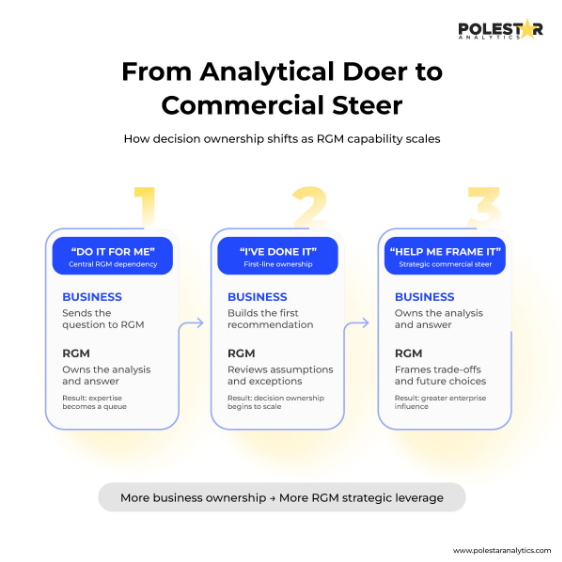
This makes RGM less necessary for transactions but, as he sees it, more strategically influential. It also creates the capacity for the function to move upstream.
Instead of treating RGM transformation as a single strategic move, it is better to think of it in a staged approach.
Stage 1: Sunlight
The journey begins, he said, by creating a shared view of price realization, promotion performance, mix and margin. The objective is not more reporting. It is one trusted commercial baseline.
At this stage, RGM leads much of the analysis. Sales and finance are the primary users, and the first measure of progress is whether teams stop debating the numbers and start discussing the decision.
Stage 2: Action
Once the baseline is trusted, he explained, the insight can change what happens next. Teams revise a weak promotion before execution, challenge a pricing exception or redirect customer investment.
This is where first-line ownership becomes real. Sales owns the customer decision within agreed economics. RGM sets the guardrails. Finance supports the review of material exceptions.
Stage 3: Navigation
As the business becomes more capable, he described RGM moving from reviewing past performance to shaping price-pack architecture, portfolio design, innovation and longer-term commercial planning.
"You're not designing a compass anymore. You're designing Google Maps that helps you understand where do you want to go and what are the places that you go to get there."
A commercially attractive pack will not scale if it cannot be produced economically. An efficient pack will still fail if it does not answer a consumer need, so instead of just the direction, RGM needs to shape the strategic decisions. Operations, insights and factory capability leaders therefore need to be involved before the strategy is complete, not after.
Stage 4: Enterprise Capability
At the final stage, in his framing, RGM thinking is visible in decisions even when an RGM practitioner is not in the meeting. Sales, finance, marketing and operations use shared evidence and guardrails to resolve trade-offs.
His practical test, offered to the panel, is simple: the model should continue working when its architect goes on vacation.
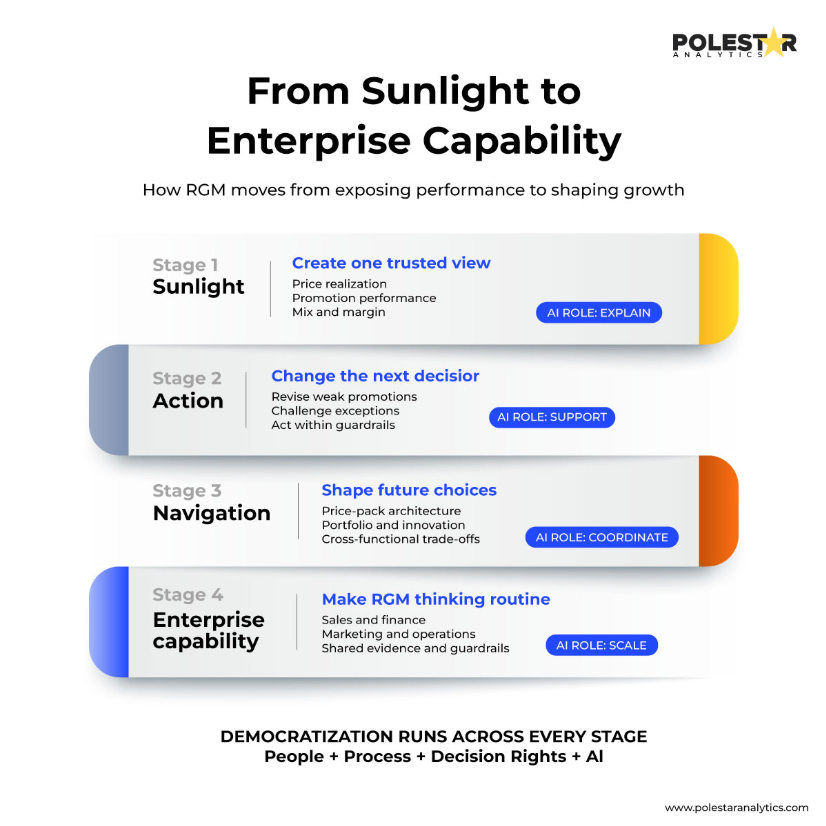
This progression also clarifies the role of AI. AI is not a separate RGM transformation. It is an accelerant that can make each stage easier to scale.
A 2026 BCG and Consumer Goods Forum survey found that 75% of participating CPG companies remained in pilots or exploration, while only 18% were scaling significant impact. More than half of all respondents did not formally measure AI ROI.
He says that AI can accelerate the journey differently based on the stage you are in.
- At the sunlight stage, AI can explain the recommendation. Generative AI can help users ask why an action was recommended, which assumptions mattered most and what changes if a constraint shifts. This makes advanced analytics easier to challenge and reduces unexplained overrides.
- At the action stage, AI can build capability in the flow of work. Bite-sized learning can be paired with generative AI so that a user receives support while reviewing a promotion or pricing decision. He described the experience as having "an expert put their arm around your shoulder" and meeting the learner where they are.
- At the navigation stage, AI can begin coordinating more of the workflow. Agentic AI could eventually connect analysis and actions across pricing, promotion and customer planning. But it requires consistent data, clear permissions, escalation rules and human approval points.
"It's not AI's fault. It's our fault. It's our own workflows, our own data, all of that."
Autonomy should therefore increase only as the operating model matures. A read-only agent explaining promotion performance should not face the same governance as an agent reallocating trade investment. Gartner recommends matching governance to an agent's autonomy and access.
For now, his view is that the fastest value is likely to come from generative AI that improves understanding and capability. Agentic AI follows when the decision process is ready to support it.
But even the right AI use case will not scale if the organization continues to reward the old behavior. That brings the journey back to people and process.
As the roundtable moved toward what makes all this stick, Colin distilled four disciplines from his own experience that can turn the operating model into sustained behavior.
- Align incentives early: If sales is measured on volume and finance on margin, expect friction.
- Start where impact is highest: Pair a material decision with someone empowered to act.
- Measure value: Track decision speed, adoption, overrides, guardrails, and commercial impact.
- Learn from failure: Every failed pilot should improve the next one.
Storytelling, he added, connects these disciplines. RGM leaders must explain what is changing, which trade-off is being made and why the total commercial outcome matters more than one functional metric.
The future RGM function, he believes, will not be the team that receives the most requests. It will be the function that makes high-quality commercial judgment repeatable across the enterprise. Also, democratizing RGM does not only improve pricing, promotion and portfolio decisions. It builds commercial leaders who can connect the consumer, customer, operations and P&L.