 Astha ChadhaThe weems of data
Sign up to receive latest insights & updates in technology, AI & data analytics, data science, & innovations from Polestar Analytics.
 Summarize this blog post with:
| AI agent observability is the runtime practice of tracing, measuring, and governing every decision autonomous enterprise agents make, turning reasoning into auditable, debuggable behavior. |
Editor's Note: This article is aimed at data practitioners, AI platform managers, and enterprise architects implementing AI agents within business planning processes (demand, supply, finance, trade promotion). The audience is expected to be familiar with LLMOps, and the article dives right into observability issues of today's stacks.
The difficult figure is this: According to Gartner, over 40% of agentic AI initiatives will fail due to rising expenses, lack of business value, and inadequate risk management by the end of 2027. On the other hand, only 23% of organizations are scaling an agentic AI system anywhere in the enterprise (McKinsey, State of AI). Gartner's 2026 CIO Survey suggests that 17% of agents have been implemented.
The pattern behind those numbers is not model quality. It is visibility. Planning agents, the ones rewriting forecasts, reallocating budgets, and executing trade promotion decisions, are operating across systems where traditional APM tools go silent. Uptime is green. Latency looks fine. The agent still recommended a stockout-inducing reorder point using a deprecated demand signal, and nobody can reconstruct why.
That reconstruction problem is what AI agent observability exists to solve.
Observable AI refers to the capability to monitor, interpret, and manage the run-time behavior of autonomous AI agents across the full spectrum of the decision-making pipeline from user intent, planning thought process, selection of the tool, retrieval of data, adherence to policies, to action. This is different from LLM observability which focuses on prompts, tokens, and latency, leaving enterprise risks exposed in the semantic layer.
In enterprise planning contexts, this means answering three questions on demand:
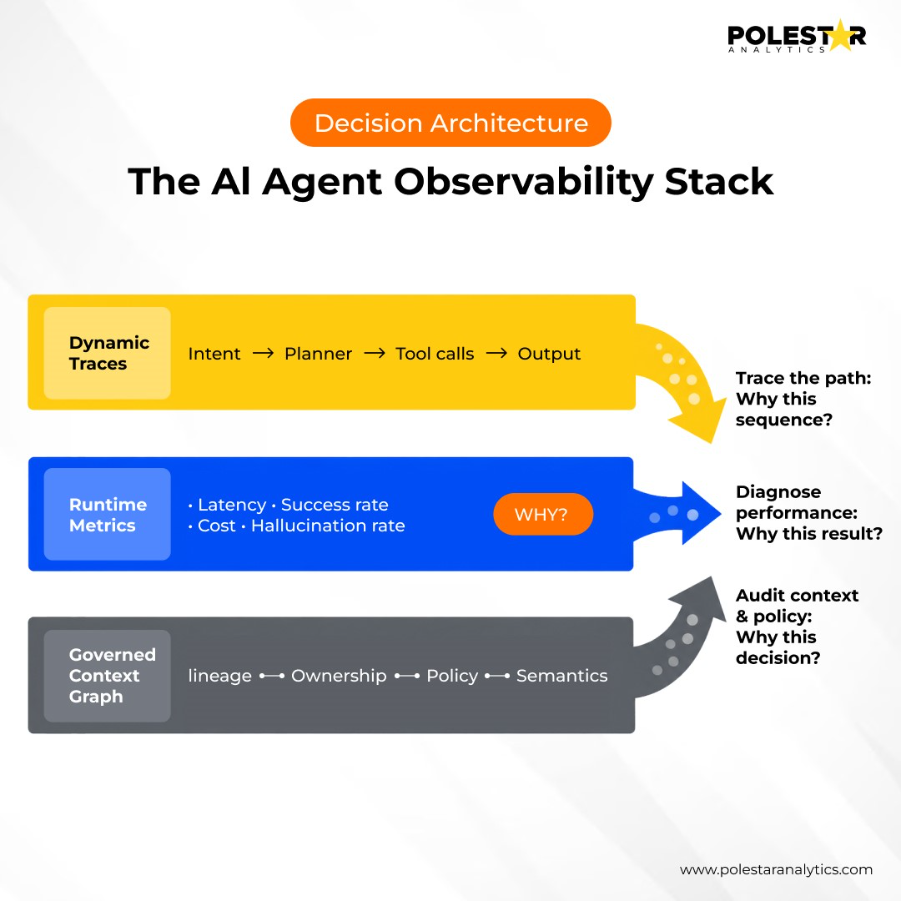
Effective agent observability rests on three interlocking layers. Each addresses a failure class that the others cannot see.
| Component | What It Captures | Failure Class It Prevents |
|---|---|---|
| End-to-end dynamic traces | Full chain of intent, planner decisions, tool calls, data reads, outputs | Silent tool misuse, unexplained decisions |
| Runtime metrics | Latency, cost, success rate, token efficiency, hallucination rate | Cost blowout, quality regression |
| Contextual logs tied to a governance graph | Lineage, ownership, policy state, semantic definitions at time of decision | Compliance breach, shadow agents, context drift |
Traces alone tell you what happened. Metrics tell you how often. Only the governance-linked log layer tells you why, which is the layer most planning teams skip and then rebuild after their first postmortem.
An enterprise-grade AI agent observability platform must go beyond dashboards. Based on IBM's Think 2026 CEO Study finding that only 25% of AI initiatives have delivered expected ROI; the discriminating factor between the winners and the abandoned pilots is a specific capability stack:
These AI agent observability capabilities are what convert monitoring from a reactive dashboard into a control plane for autonomous planning.
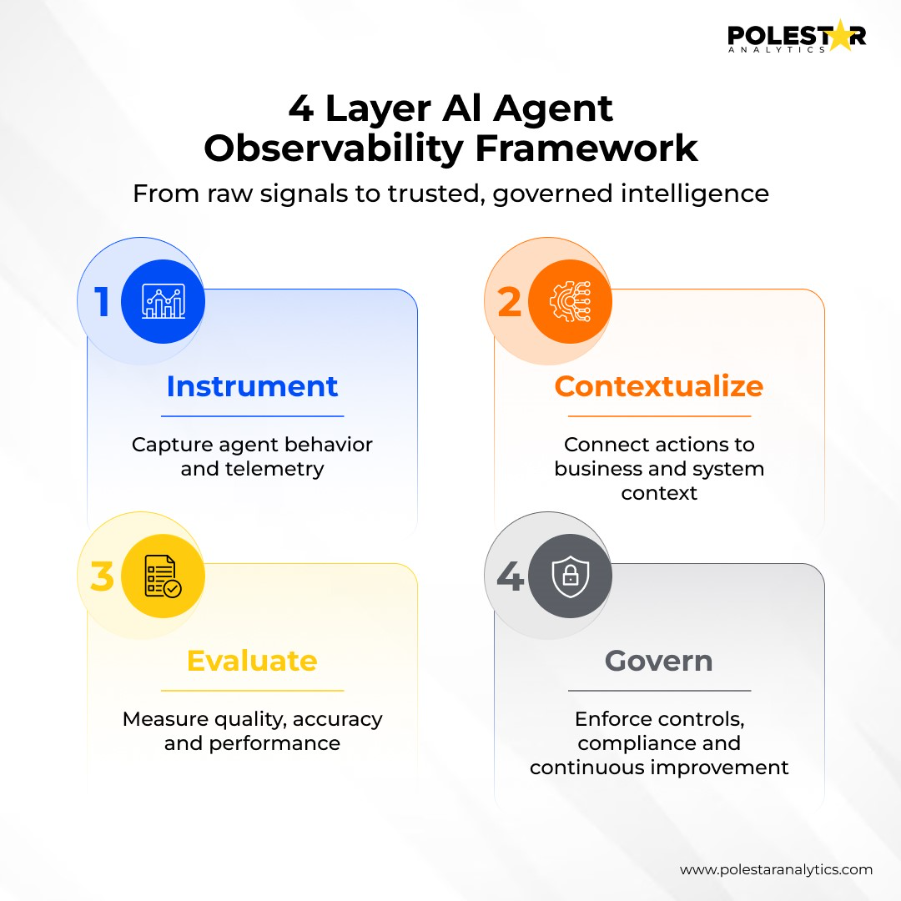
A practical AI agent observability framework for enterprise planning maps to four layers:
This layered pattern is what separates effective AI agent observability from a Grafana dashboard bolted onto an LLM gateway.
The AI agent observability tools market splits into three camps, and enterprise planning teams typically need components from all three:
The gap that trips up most enterprise stacks: instrumentation without governance context. You can see the tool call. You cannot see whether the dataset it queried was certified, owned, or already flagged as low quality. That is where 80% of enterprise applications shipped in Q1 2026 embedding at least one AI agent (Gartner) are exposed.
Four practices consistently distinguish planning teams whose agents survive the transition from pilot to production:
Polestar Analytics is an Anaplan implementation partner and AI delivery partner, building AI-enabled connected planning solutions for finance and supply chain teams. We design observability into agentic planning from the architecture stage, not as a post-deployment layer. Across integrated business planning, trade promotion optimization, and financial planning, we embed trace instrumentation, context binding, and evaluation loops directly into the agent lifecycle.
The pattern Polestar Analytics deploys for planning clients:
The result is planning autonomy that leaders can defend to auditors and to the CFO, not just demonstrate to a review committee.
Trust is based on transparency, not autonomy. Observability of the AI agent documents all decisions made during the planning process along with the information sources, reasoning processes, tools used, and governance policies affecting that decision. This lets business leaders validate why an agent recommended a forecast adjustment, inventory change, or budget reallocation before acting on it, making autonomous decisions explainable and auditable.
Observability is an end-to-end execution trace that captures everything from the request made by the user to the reasoning process used, the tool calls made, data sets used, and the policies checked. This helps one determine the reason behind the problem and whether it was due to use of outdated data or data not certified, wrong business rules, wrong tool call, or wrong reasoning.
It helps to prevent the following problems that may arise in organizations: making decisions using outdated or uncertified data, violations of policy, hallucinations, unauthorized AI agents running in the background, and changes in the definition of context.
Observability is a collective responsibility, where the AI platform team takes care of instrumentation and runtime monitoring, the data governance team guarantees trusted context and lineage, while business teams still retain accountability for the agent's objective, decision-making limits and its results. This collaborative model ensures that autonomous agents stay aligned with the business strategy in their lifecycle.
It enables organizations to scale their AI agents beyond the pilot stage through making decisions measurable, understandable and improvable. It increases speed of resolving incidents, debugging, improves compliance and helps the team to detect performance bottlenecks before they affect planning decisions. Consequently, enterprises scale their AI initiatives with minimum operational risks and maximum business value.
About Author
The weems of data
In data, as in chess, the real power lies in foresight.
Related Blog
 Nitin Kumar