
Summarize this blog post with:
The most recent PwC Working Capital Study — covering 19,000 listed companies — found €1.84 trillion in excess working capital sitting idle on global balance sheets. This is not borrowed capital or future revenue. It is cash that companies like you have already earned. They’re trapped in slow receivables, over-funded payables, and surplus inventory you have not yet mobilised.
For reference, it was €1.56 trillion the last year. The gap seems to just be widening further. For a CFO sitting in front of a board that expects the balance sheet to work harder, this is not an abstract macro figure.
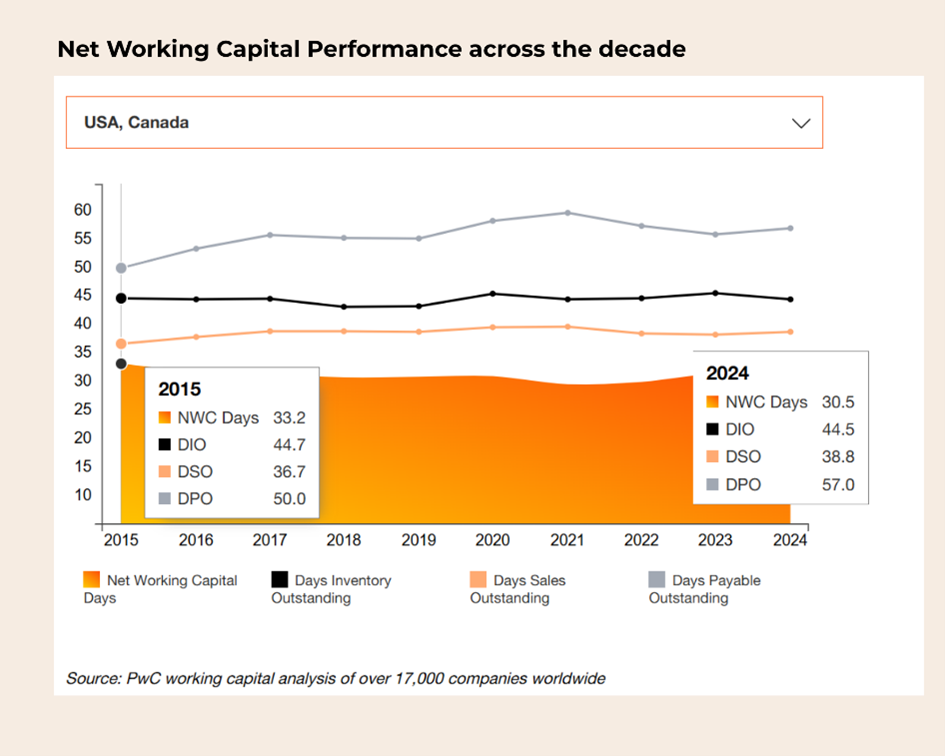 PWC study showing the net working capital performance across the decade
In a liquidity crunch, the instinct is to pull every lever. But the most impactful decision a CFO can make is often avoiding a high-effort, low-impact action that might damage supplier relationships or worsen long-term cash positions.
To enable that our AI-powered working capital application system, CapitalPulse introduces the "Anti-Recommendation" engine. Unlike legacy automation that blindly chases a target metric, this engine evaluates the "effort vs. impact" of every potential move.
CapitalPulse organizes its recommendations into clear categories—Receivable Optimization, Payable Optimization, and Inventory Strategy—so the CFO can evaluate interventions by domain rather than as a flat list.
To build executive trust, every suggestion is presented with four structured elements:
- Description: A clear, actionable statement of the proposed intervention.
- Impact: The estimated financial benefit to working capital (e.g., “$15–20M recovery within 30 days”).
- Effort: Categorization of resource requirements—Low, Medium, or High.
- Rationale: The LLM-generated logic-bridge, grounded in actual company data, explaining specifically why this action addresses the underlying root cause.
Each recommendation carries an “AI Recommended” badge when the system has high confidence, and a selectable checkbox allows the CFO to accept or reject actions before they flow into the Action Tracker.
The traditional working capital review cycle is built around reporting cadence, not business reality. A DSO spike that starts in week one of the month gets picked up at month-end. Between the time for investigation and action, the cash opportunity has a four to six week tail on it.
AI-driven anomaly detection monitors working capital KPIs continuously — DSO, DPO, CCC, inventory days — across the full AR aging stack, payables ledger, and procurement data.
Within CapitalPulse, we call this Command Center.
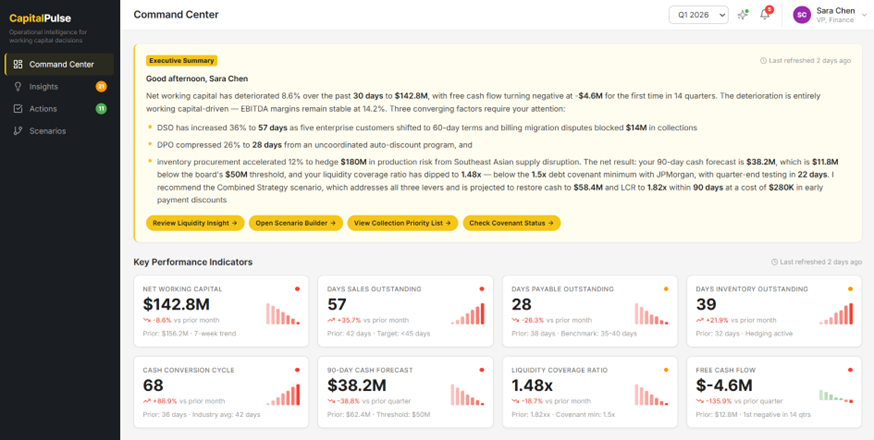
This monitors eight core working capital KPIs across 13 data domains in real time. Its Active Insights Feed flags risk shifts before they become crises — and its AI Executive Briefing gives the CFO a plain-English summary of what changed overnight and what it means, replacing the morning ritual of logging into fourteen separate dashboards.
45% of FP&A time currently goes to data collection and validation. Only 35% goes to analysis and decisions.
AI root cause diagnosis inverts that ratio, freeing the team to act rather than assemble. It changes this by doing the cross-system correlation automatically. When DSO spikes, the system checks whether the movement is concentrated in a specific customer tier, a specific geography, or a specific billing cycle. It checks whether AP delays in the same period suggest a broader liquidity squeeze in the supply chain.
In CapitalPulse, each insight is grounded in specific root causes:
Supported by data tables, trend charts, and tagged evidence markers like “DSO: 42 → 57 days (+36%)” and “$28M in aging receivables >30 days”—eliminating the analysis paralysis that stalls enterprise finance teams.
The primary barrier to AI adoption in the finance office is the "Black Box" fear—the dread of an algorithm making a high-impact decision based on a hallucination. To overcome this, technologists have moved toward "Radical Traceability."
CapitalPulse's Action Tracker enables this by converting approved strategies into assigned tasks with owners and due dates. Its Audit Trail logs every AI detection, human decision, and execution event, with timestamps and data evidence (e.g., “CRITICAL Insight INS-001 detected: Liquidity pressure within 60–75 days; AI Engine”).
With AI conversational assistant built into the your working capital platforms (to act as an active, on-demand financial analyst), you can get
- Proactive, Context-Aware Suggestions: Offers time-of-day awareness and dynamically generates suggested questions based on the specific data the executive is currently viewing
- Rich Data Responses: It delivers answers through both narrative text and fully formatted inline data tables
- Global Accessibility: It persists across page navigations, allowing CFOs to interrogate data seamlessly at any step of the remediation pipeline without losing their place
| Feature |
Traditional Workflow |
CapitalPulse Workflow |
| Visibility |
Siloed data & manual exports |
Real-time, 13-domain unified view |
| Analysis |
Days of forensic spreadsheet tracing |
Instant AI root-cause diagnosis |
| Strategy |
"Blind" execution of tactics |
Validated "what-if" simulations |
| Manual Labor |
Reissuing invoices & manual T&E |
Automated reissues & policy enforcement |
| Execution |
Disconnected email chains |
Closed-loop Action Tracker |
The ones listed up are the top five features of how AI helps improving working capital management, but it is not limited to these
- AI-driven action tracking – Converts approved strategies directly into assigned tasks with owners, due dates, and financial impact targets. Every action is traceable back to the anomaly that triggered it and the model that validated it.
- Making intended consequences with Anaplan bridge - When a CFO selects a scenario from the Scenario Builder, CapitalPulse transmits a complete data package—including updated collection assumptions, payment term adjustments, and procurement commitments—directly into three dedicated Anaplan planning models
- AI-driven scenario planning - CFO can define two or three potential responses to a working capital problem Eg. Accelerate AR versus extend AP versus adjust inventory purchasing, and see a side-by-side projection of their 90-day cash impact
If the answer is measured in days, or involves multiple analysts pulling data from separate systems, you have an action gap and you can quantify its cost against your revenue base.
Most cannot. The inability to stress-test operational moves against financial covenants is not a treasury failure. It is a systems architecture failure.
If the FP&A Trends benchmark holds — 45% on data collection, 35% on analysis — your team is spending more time building the case than making it. Benchmarked from - FP&A Trends Survey 2024.
P.S. To know more about the results we’re seeing with CapitalPulseAI for working capital management. Talk to our experts today.
CapitalPulse is a working capital intelligence platform built by Polestar Analytics for CFOs and finance leadership teams. The platform provides an AI-driven closed-loop workflow that detects anomalies, diagnoses root causes, recommends corrective actions, simulates financial outcomes via the Anaplan Bridge, and enables execution tracking through the Action Tracker. For more information, please contact marketing@polestaranalytics.com