
Summarize this blog post with:
| Procurement spend leakage is a control problem hiding as a data problem. It closes only when every transaction is traced end to end. |
TL;DR
Procurement spend leakage is a control problem, not an invoice problem and AP automation was never built to close it. It hides in five upstream seams across contract, requisition, PO, receipt, and invoice, each living in a different system. ProcurePulse runs a knowledge graph and three way match across all of them, so every finding traces back to source. These numbers then combine into an acquisition maturity score between 0 and 100 for each business unit, thus making the leak become a number for managers to use.
Enterprises have invested heavily in procurement controls, contracts and AP automation. Yet visibility into where procurement spend leaks remains limited. An Efficio survey of 300 CPOs, CFOs and senior leaders at companies with more than £1 billion in sales found that 85% said more than a quarter of their indirect spend had no financial oversight, while only 19% reported full visibility into indirect spend. The same survey found that 93% identified maverick spending as a major contributor to cost leakage.
The problem is not necessarily a lack of data. It is the disconnect between the records that explain how a purchase happened.
A contract may define the right price, but the buyer may purchase outside it. A PO may exist without the right requisition or approval trail. Multiple POs may be raised to avoid an approval threshold. An invoice may not match what was ordered or received. Or the same obligation may be paid more than once.
Each may look like a separate exception. Together they reveal where the procure-to-pay chain breaks.
The chain goes from contract to requisition to purchase order to goods receipt to invoicing and payment. If there is a disconnect among these documents, procurement professionals will be able to see each transaction separately but not the bigger picture.
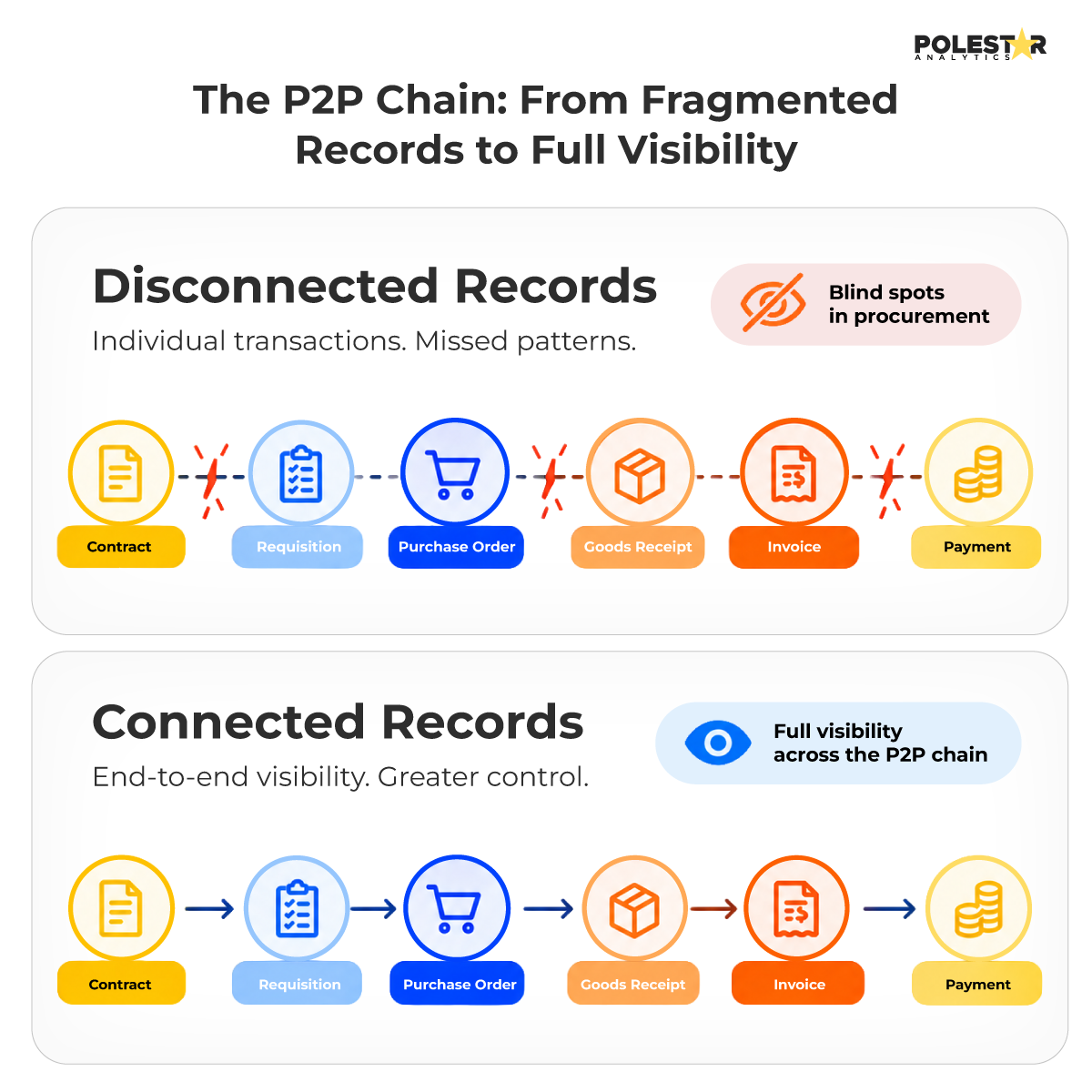
So where does procurement spend leak? Here are five hidden gaps across the procure-to-pay cycle.
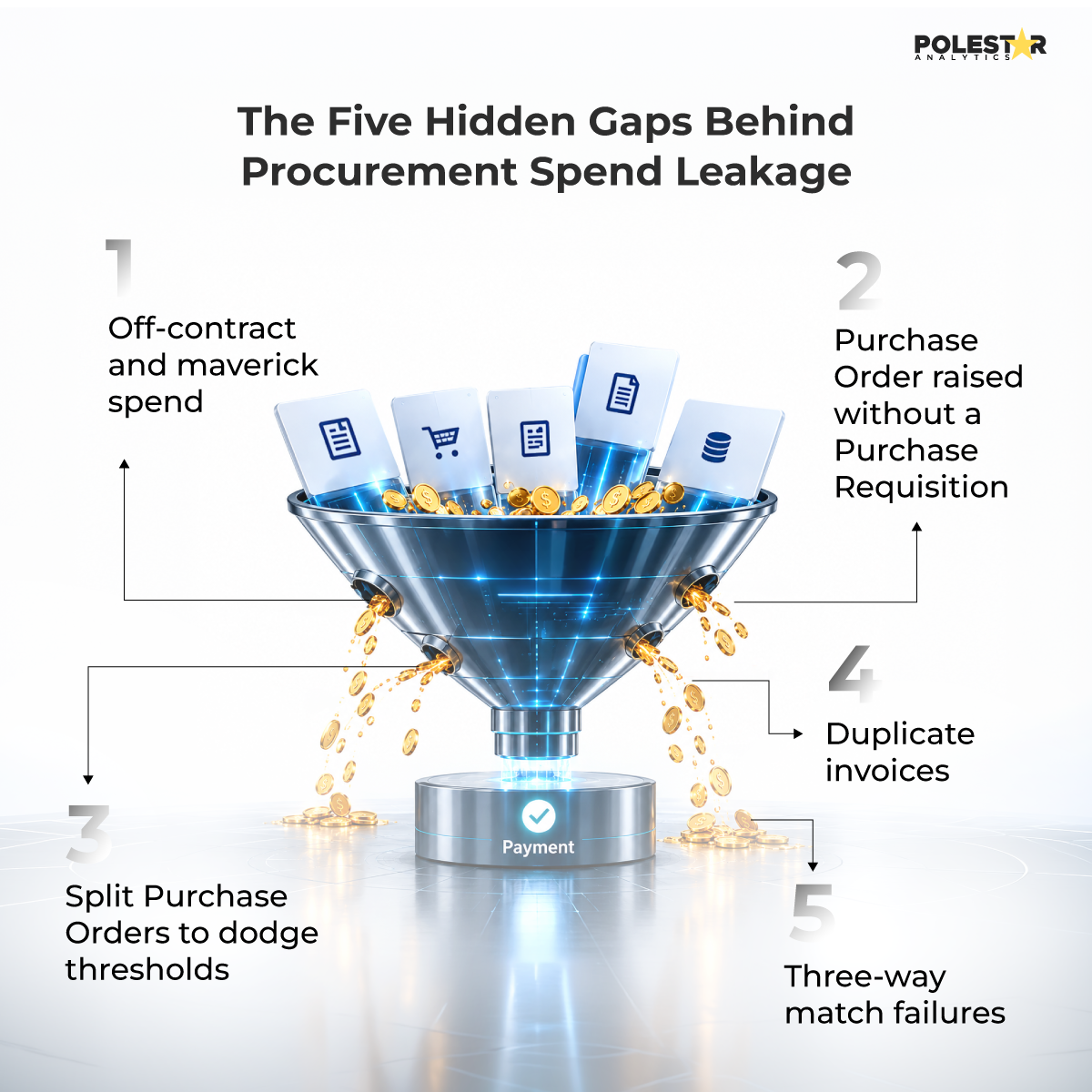
1. Off-contract and maverick spend
An organization negotiates a special deal with one supplier, yet the employees continue purchasing from another supplier in that category since it is quicker or easier. Each of those transactions is without the negotiated discount. Spread across a business unit, this fragments buying power and quietly erodes the savings the contract was supposed to lock in.
2. Purchase Order raised without a Purchase Requisition
A supplier delivers, and a PO gets raised afterward just to match the invoice already in AP. No requisition ever existed to approve the spend in the first place. This doesn't always mean money was lost, but it means the approval trail is broken, nobody can prove the purchase was authorized before it happened. Most organizations approve only 28% of invoice lines through true three-way matching, leaning on weaker checks instead.
3. Split Purchase Orders to dodge thresholds
One purchase becomes two or three POs to stay under an approval bar. For instance, a supplier billed $23,000 three times in ten days clears every time, though together it is $69,000 that should have triggered review. Contract splitting is a recognised fraud pattern, not just a workflow accident.
4. Three-way match failures
Price varies, quantity varies, or there's no receipt to begin with, but AP pays out because the queue for exceptions is too large to go through. The best-of-the-best AP departments operate at 9% exception rate compared to an industry-wide 22%, meaning that one-fifth of the invoices still require human intervention.
5. Duplicate invoices
Same invoice under a slightly different number, same vendor across two master records, same PO billed twice weeks apart. Exact-match logic misses these; matching across vendor, amount, and a short window catches them before payment. Duplicate payments run 0.1% to 1.5% of invoices without automation.
In combination these gaps reflect a larger issue. As procurement leakage does not happen due to one failure in the process; rather it is due to misalignments within the entire transaction chain. Solving this problem requires visibility into contracts, requisitioning, POs, receipts, invoicing and payment. This is where ProcurePulse fits into the picture.
ProcurePulse is an AI-based procurement intelligence tool that provides insight into spend leakages, tracking payments, identifying process failure areas, and calculating the financial implications.
It links suppliers, contracts, requisition, PO, goods received, invoices, and payments to provide one transactional view that helps procurement management understand where the purchasing process fails, why it fails, who is responsible, and the cost of failure.
From Exceptions to Root Causes
ProcurePulse goes beyond identifying individual exceptions to uncover the process issues driving procurement leakage:
- Connects the purchasing lifecycle end to end through a transaction graph.
- Detects control breakdowns such as maverick spend, contract breaches, duplicate invoices, three-way-match failures, missing receipts, and split POs.
- Identifies root causes, not just downstream exceptions.
- Traces every finding to transaction-level evidence for clear, explainable results.
- Helps teams move from identifying an exception to knowing what happened, what it cost, and where to act.
- See where spend is leaking. Get a consolidated view of on-contract, off-contract, compliant, and leakage-prone spend and identify underutilized contracts.
- Trace payments end to end. Trace payments through the invoice, PO, and contract to find where the chain breaks, quantify the impact, and identify the owner.
- Fix root causes. Connect exceptions across the purchasing lifecycle to identify the upstream process failures driving recurring leakage.
- Quantify financial impact. Turn procurement exceptions into measurable financial impact, helping teams prioritise the highest-value opportunities.
- Measure procurement maturity. Score business-unit procurement health from 0–100 using actual transaction data, enabling leaders to identify gaps and track improvement.
- Monitor supplier risk. Connect external signals such as supplier bankruptcies and regional disruptions to the supplier base and quantify potentially affected spend.
See ProcurePulse in action:
Spend leakage is money leaving the business it should not, through duplicates, price mismatches, or off contract buys. Procurement savings leakage is negotiated value that never gets captured, usually because the catalogue, the buyer or the invoice does not know the newer price. ProcurePulse detects both because both live in the same chain.
Usually not. AP automation owns capture, routing and payment. The 2026 Gartner Magic Quadrant for AP Applications evaluates that category well. ProcurePulse sits on the data layer beneath and tests whether the invoice was owed, priced right, and received. The two are complementary, and Polestar Analytics deploys ProcurePulse platform-agnostically on Databricks, Fabric, Snowflake, or Azure.
With contracts, POs, receipts, and invoices in a cleansed gold layer, a first leakage baseline typically runs in weeks, not quarters. If the data foundation is not there, Polestar Analytics builds it through its data engineering practice before the leakage view goes live.
In the price mismatch and off contract slices. Both compound quietly, and both show up cleanly once contract terms sit next to actual paid prices at line level. The comparison is also the quickest way to recover money for most firms, and it's the starting point in the usual Polestar Analytics procurement analytics engagement process.
- Automation is not visibility. Invoice capture without a chain view leaves procurement cost leakage untouched.
- Five seams, not one. Off contract buys, PO without PR, split POs, match failures, and duplicates.
- Exceptions are not findings. Route each exception to the seam that caused it, or the queue owns the process.
- Score the unit, not the transaction. A maturity index per BU shows where discipline is improving and where it is not.
- The proof is in the transaction. Every finding ProcurePulse produces is traceable back to the invoice, PO, and contract behind it.