
What is Sales Force Effectiveness (SFE) in Pharma?
Sales force effectiveness in pharma plans field coverage: which physicians reps see, how many reps, and whether that coverage moved prescribing.
Sales force effectiveness in pharma is the practice of planning and measuring field coverage: which physicians reps see, how many reps are needed, how territories are drawn, and whether that coverage moved prescribing. The pressure on these decisions has grown. The 17 largest pharma companies reduced headcount by more than 22,000 in 2025, with a projected $300 billion revenue loss from patent expiries through 2030, so most teams are now deciding which physicians to stop covering.
What separates it from sales management elsewhere is that the person being engaged does not complete the purchase. A doctor prescribes, a payer pays, a patient consumes, and a health system influences what is easy to prescribe. Like pharma commercial analytics, assessing sales force effectiveness in pharma requires an integrated view of prescription data, call history and market signals, not call count alone.
Three components account for most of the outcome. Incentive design, training and content perform according to whether these three are right.
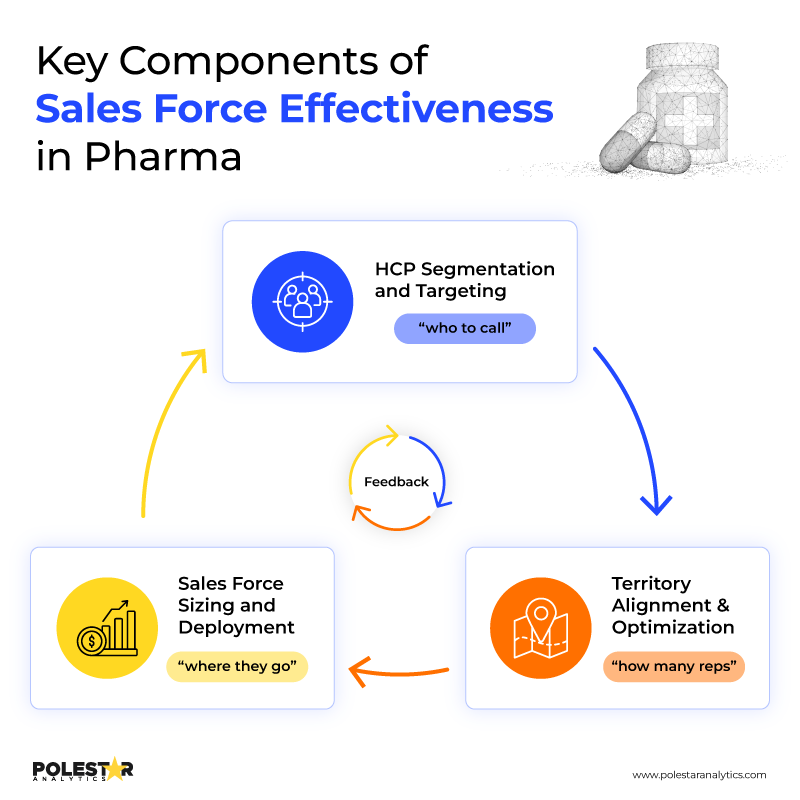
Sizing, deployment, and the implementation problems that turn up after the model is signed off.
AI has altered the cadence of SFE more than its components. Scoring that ran annually can run continuously, and the output reaches the rep as a prioritised action rather than a report to interpret.
Results so far are uneven. In Deloitte's 2026 survey of life sciences leaders, 71% said AI deployment had advanced over the past six months, 45% reported measurable improvement, and 13% at scale. McKinsey's 2026 AI Trust Maturity Survey found security and risk are the top barriers to scaling agentic AI, with fewer than one in four organisations having moved agents into production.
Within pharma commercial teams, AI and analytics contribute in five places: assembling a 360 HCP profile across CRM, prescription and third-party data; spotting behaviour shifts while they are still actionable; recommending channel and message per HCP; sequencing visits so more of the week is spent with customers; and next-best-action alerting on trigger events.
The bottleneck on all five is data readiness. A model built on fragmented data produces confident target lists that field teams do not act on, so the data layer has to be in place before the decision layer is worth deploying.
The two terms overlap substantially and are often used interchangeably. The distinction that holds concerns scope.
| Point of Difference | Sales Force Effectiveness (SFE) | Field Force Effectiveness (FFE) |
|---|---|---|
| Scope | The commercial sales organisation | All customer-facing field roles: MSLs, KAMs, nurse educators |
| Objective | Prescription and revenue outcomes | One coordinated experience across commercial and medical |
| Typical owner | Commercial leadership, sales operations | Commercial or field excellence |
| Where it falls short | Credits the rep for adoption that medical and digital actually drove. | Harder to tie to revenue, since medical is not judged on sales |
Omnichannel teams tend toward the FFE frame, since it accommodates medical and digital contributions a sales-only measure excludes. Either way, the harder problem sits in execution rather than analysis.
The test for any tool in this layer is whether it turns a leader's quarterly objective into a named list of physicians for each rep next week, with a reason attached to each name.
That is where most SFE programmes drop off, and what to evaluate against, whether you buy HCPPulse or build the workflow yourself. See HCPPulse in action.
Sales force effectiveness in pharma needs paired metrics, since neither activity nor outcome proves much on its own. Activity metrics cover reach, share of voice, frequency and call plan adherence. Outcome metrics compare TRx and NRx movement in covered territories with matched uncovered ones, alongside cost per engaged target. Coverage can rise while prescribing stays flat, and prescribing can rise for reasons unrelated to the field. Most disputes over SFE results come down to a missing comparison group, which is why pharma commercial teams increasingly run activity and outcome on a single surface like HCPPulse rather than in separate reports.
Less often than most companies do. Annual realignment is common, and though a well-executed one can lift revenue by up to 7% with no added headcount, a badly executed round destroys value at similar scale, showing up later as attrition and unexplained underperformance. For pharmaceutical sales force effectiveness, a better trigger is evidence that the map is wrong: workload imbalance, unreachable quotas beside exhausted target lists, or a shift in where priority physicians practise. Where the brand holds exclusive access with a physician, keep the rep in place.
Four sources, joined and governed: CRM engagement history, prescription data, third-party HCP reference data on affiliations and specialties, and current territory and alignment records. Joining them is the hard part. When they sit in separate systems with inconsistent HCP identifiers, models produce target lists that reps recognise as wrong and stop using. Programmes that reach field adoption usually put the commercial data foundation in place before the decision layer.