
Sammanfatta detta blogginlägg med:
| Build AI agents on Databricks for retail by declaring the task in Agent Bricks, grounding it in governed data, then evaluating and deploying inside the Lakehouse. |
TL;DR
Most of the time, AI pilots in the retail sector don't fail in a loud fashion; instead, the implementation is simply abandoned somewhere in between their proposal and their actual implementation. Getting an agent to behave reliably on live retail data is far harder than any demo suggests. To fill the gap between evaluation and governance, Databricks AI agents work based on the principle of evaluating the systems during the implementation process. Databricks Agent Bricks lets teams describe an agent's task in plain language, connect enterprise data, and let the platform handle benchmarking, tuning, and cost optimization. The path to production runs through a repeatable four-step loop, grounded in Unity Catalog governance from day one.
Most retail AI pilots don't fail loudly. They fade. A team stands up a slick generative AI demo, receives the nods, but then the whole thing stalls in between other things. Blame rarely lands on the model. The real culprit is that making an agent behave reliably, cheaply, and safely on live retail data is a great deal harder than the demo let on.
Closing that gap is precisely what Databricks has been chipping away at for the past year and it is the reason so many teams are now rethinking how to build AI agents on Databricks. And the demand is not hypothetical: per the 2026 State of AI Agents report that Databricks cites, 40% of the top AI use cases now revolve around customer experience, which is the very core of retail. For most retailers, the question has stopped being whether to build AI agents for retail. It is how to drag them out of pilot purgatory and into production.
Retail lives on decisions that are relentless, high-volume, and clock-sensitive. Who's about to churn, which SKU is about to run dry, which promotion is quietly bleeding margin. None of these is a one-and-done analysis. They are exactly the repetitive, data-anchored judgment calls that Databricks AI agents were designed to take on.
An AI agent is not the same as a chatbot or a basic retrieval software. An AI agent works as a reasoning engine. It is able to analyze a task and utilize SQL or Python to solve the problem, and to second-guess its results and work on the problem continuously until receiving a verified outcome. In retail, the agent is able to move from a simple command like "show me last week's sales" to a much more complicated one like "locate three regions with diminishing margin, determine what has caused this, and prepare a reorder." The conversation isn't the point. The action at the end of it is.
The sticking point has always been trust and cost. Skip proper evaluation and teams wind up grading agents on gut feel, which is how unsteady quality and ever increasing token bills quietly sink projects before they ever scale. As per the 2026 State of AI Agents report, companies that use evaluation tools get nearly 6x more AI projects into production; for those using AI governance, it's over 12x more.
 Source: Databricks
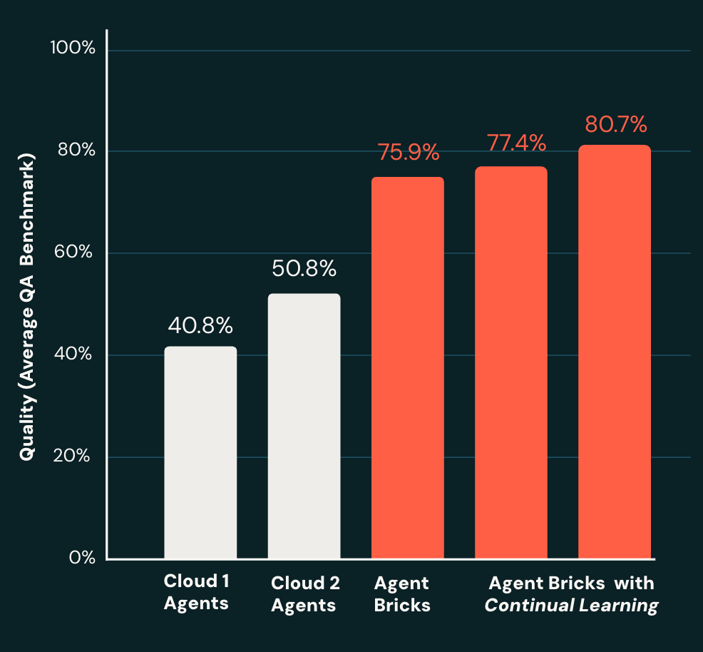
Databricks Agent Bricks is the platform's response to that pilot-to-production trap. Instead of hand-tuning prompts and lashing together a pile of separate tools, you spell out the agent's task in plain language, plug in your enterprise data, and let the platform take care of evaluation and optimization.
The uptake suggests the bet is paying off. Since the launch of Agent Bricks at the Data + AI Summit 2025, more than 100,000 agents have been created on the platform, with over 1 quadrillion tokens used annually. Some large retail chains like 7-Eleven have already started operating on the Agent Bricks. From the retailer's perspective, the main benefit is that those solutions provide everything necessary for building production-level agents, such as guardrails, governance, and cost management.
The speed can catch you off guard. Let's look at one case in a situation outside the retail sector. AstraZeneca implemented Agent Bricks in more than 400,000 files and was able to obtain structured data in less than an hour without having to write any code. Understanding the Databricks Agent Bricks architecture helps here. The technology is built on the Lakehouse infrastructure and offers the approach whereby evaluation, optimization, and governance are combined into one process instead of relying on a few separate technologies that require being integrated.
Going from idea to deployed agent runs through a repeatable loop, and getting your head around it is the quickest way to get started with AI agents on Databricks.
Start by declaring the task. You pick the agent type, write a short natural-language description of what it should do, and connect your data sources. Databricks boils this down to describing the outcome and connecting your data, with Agent Bricks handling the rest. This is also the simplest way to create an AI agent on Databricks without hand-wiring a stack of tools.
Next, let it evaluate on its own. This is the step most teams breeze past and pay for later. Agent Bricks builds task-specific evaluation benchmarks, sometimes by synthetically generating fresh data or spinning up custom LLM judges, so quality gets measured against your actual task rather than some generic leaderboard.
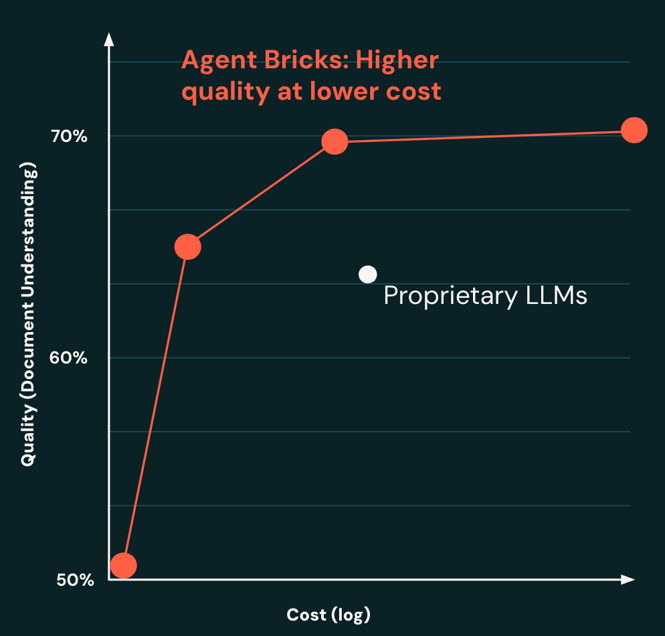
Then optimize for quality and cost together. Drawing on techniques from Mosaic AI Research, the platform tunes itself to weigh accuracy against latency and spend, sparing teams the grinding trial-and-error that makes agents costly to keep running.
Finally, deploy without leaving governance behind. Because the agent runs inside the Lakehouse, Unity Catalog governance, lineage, and access controls hold from day one, and that is what lets an agent move from experiment to something you'd actually trust in front of customers. That governed foundation is the part of the Databricks Agent Bricks architecture that separates a shippable retail agent from a demo.
 Source: Databricks
The most solid starting point among Databricks AI agents use cases is the decisions retailers are already making every day. An ideal way to start is through personalization: the global giant of convenience shop, 7-Eleven, utilizes Databricks so that the marketing personnel can make customer offers directly from a regulated platform without relying on complicated SQL queries. 7-Eleven technicians cut maintenance document search time by up to 60% using an AI-powered Technician's Maintenance Assistant built on Databricks. Agent Bricks unified vector indexing and observability, reducing latency by over 40%.
Past personalization, Databricks describes agents that keep watch on risk signals and optimize inventory in real time, alongside demand forecasting, promotion-ROI analysis, and agentic commerce where AI helps size up products on a shopper's behalf. They all share one silhouette: a repetitive, data-heavy decision where acting a day sooner is worth real money.
Databricks' report draws on telemetry from over 20,000 global customers, including over 60% of the Fortune 500. The top agent use case among Databricks customers is the Supervisor Agent, which accounted for 37% of usage and orchestrates multiple agents across domains. Of the top 15 use cases, 40% focus on customer experience and engagement.
The rational approach is to pick a specific use case that has a narrow scope but has a high return on investment and is suffering from late insights. The example of this can be the stock-out prevention case or the churn prediction one. Build one agent that works with the governed data. Make sure to test your agent against the actual results and keep an eye on costs. Start with the decision that hurts the most, not the one that appears to be the best demo.
- Retail decisions are agent-shaped. Churn, stock-outs, and margin leaks are repetitive, data-heavy calls where acting a day sooner pays, which is exactly the work AI agents on Databricks are built to carry.
- Agent Bricks removes the pilot-to-production trap. Explain the objectives, link to the governed data, and the platform takes care of benchmarking, tuning, and cost management, allowing for the implementation of guardrails naturally instead of adding them afterward.
- Start narrow and governed. Choose one important decision, develop a single agent based on Unity Catalog-governed data, check its effectiveness against actual metrics, and then aim to expand its implementation instead of being tempted by various new technologies.
Retailers connect governed sales, inventory, or customer data, then describe the target decision in Agent Bricks and let it benchmark and tune. Starting with one bounded use case keeps the first build fast and measurable.
It replaces manual prompt-tuning and tool-stitching by auto-generating task-specific benchmarks and optimizing for quality and cost together. That removes the guesswork that usually stalls agents at the evaluation stage.
Agents run inside the Lakehouse, with Unity Catalog handling governance, lineage, and access while Agent Bricks manages evaluation and optimization. Data, controls, and serving sit in one place instead of scattered tools.