
Vat dit blogbericht samen met:
Noot van de redactie:Deze blog bespreekt de essentie van Industrie 4.0 en legt tegelijkertijd de basis voor de mensgerichte samenwerking die Industrie 5.0 kenmerkt. Ontdek hoe deze samenkomst van geavanceerde technologieën en menselijke innovaties industrieën hervormt en duurzame, gepersonaliseerde en doelgerichte vooruitgang stimuleert.
Stel je Tony Stark uit Iron Man voor in zijn hightech werkplaats. Zijn AI-assistent, JARVIS, regelt alles: het beheert zijn projecten, analyseert data en voert simulaties uit. Het is het perfecte voorbeeld van waar Industrie 4.0 voor staat: automatisering, efficiëntie en machines die doen wat mensen vroeger deden, maar dan sneller en nauwkeuriger. Maar dan realiseert Tony zich dat er iets ontbreekt. Hij wil niet alleen dat machines taken uitvoeren; hij wil dat ze met hem samenwerken, hem helpen creatief te denken en problemen op te lossen op een manier die alleen mensen kunnen. Deze verschuiving markeert het begin van Industrie 5.0.
Industrie 4.0 bracht ons slimme fabrieken, waar machines en systemen naadloos met elkaar communiceren. Het draaide allemaal om snelheid en precisie. Maar in de haast om te automatiseren ging de menselijke factor soms verloren. Industrie 5.0 is er om dat te veranderen. Het gaat erom de mens weer in het proces te betrekken, niet om machines te vervangen, maar om ermee samen te werken op een manier die het beste van beide werelden combineert.
De overgang van Industrie 4.0 naar 5.0 markeert het begin van een nieuwe industriële revolutie, waarin technologie een bondgenoot wordt bij het oplossen van complexe problemen met een focus op duurzaamheid, personalisatie en menselijkheid. Net als Tony Stark beseffen industrieën de kracht van mensgerichte innovatie, waardoor we dichter bij een toekomst komen waarin technologie en menselijkheid hand in hand gaan.
Industrie 5.0 is geen nieuwe industriële revolutie, maar bouwt voort op de technologieën van Industrie 4.0 door de samenwerking tussen mens en robot te versterken.
Met Industrie 5.0 worden de negen pijlers van Industrie 4.0 uitgebreid met een streven om menselijke creativiteit en welzijn centraal te stellen in de industrie – om de efficiëntie en snelheid van machinetechnologieën te combineren met het talent en de innovatie van menselijke medewerkers.
Terwijl we de vooruitgang van Industrie 4.0 ondersteunen, is het cruciaal om te erkennen hoe deze industriële revolutie de basis heeft gelegd voor Industrie 5.0, waar de focus verschuift van automatisering naar samenwerking tussen machines en mensen. Waar Industrie 4.0 productieprocessen, omzetgroei en bedrijfsvoering verbetert door middel van technologieën zoals generatieve AI, robots en sensoren, benut Industrie 5.0 deze innovaties om de besluitvorming en menselijke creativiteit te verbeteren.
Volgens McKinsey leidt de integratie van technologieën zoals GenAI met Industrie 4.0 tot aanzienlijke productiviteitswinst, zoals een verlaging van de R&D-kosten met 10-15%. Industrie 5.0 bouwt hierop voort door personalisatie, efficiëntie, mens-machine-interactie en duurzaamheid te combineren.
Het gebruik van technologieën zoals robotica, draagbare apparaten en connectiviteit verbetert de productontwikkeling in Industrie 4.0 en effent de weg voor de visie van Industrie 5.0 op oplossingen en ervaringen op maat. Door menselijke vaardigheden te integreren met geavanceerde AI zorgt Industrie 5.0 voor slimmere, adaptievere en duurzamere systemen.
Laten we, terwijl we de kernpijlers van Industrie 4.0 verkennen, eens kijken hoe deze zich zullen ontwikkelen om een mensgerichte, veerkrachtige en milieubewuste Industrie 5.0-toekomst te creëren.
The 9 Industry 4.0 pillars are advancements that bridge the digital and physical worlds and make autonomous and smart systems possible. Supply chains and businesses are already using some of these innovative technologies, but the full completion of Industry 4.0 comes at the front when used together.
1. Big Data And Analytics
AI in Industry 4.0 based on Industrial data and analytics has come out recently in the manufacturing world where it optimizes production quality, improves equipment service, and saves energy. Big data analytics in Industry 4.0 is in the context that the comprehensive evaluation and collection of data from many different sources production equipment and systems and organization- and CMS—will become standard to support decision-making in real-time.
For example, Infineon Technologies, a semiconductor manufacturer has reduced product failures by correlating single-chip data encapsulated in the testing phase at the end of the production process with process data collated in the wafer status phase in the early process. In this way, industry 4.0 analytics helped Infineon to quickly identify patterns that assist them in discharging faulty chips early in the production process and improved product quality.
2. Autonomous Robots
Manufacturers in numerous industries have used robots to tackle complex assignments, but now they’re progressing towards greater utility. They are becoming more flexible, autonomous, and cooperative. And hence, they will interact and work safely with humans and learn from them. These robots and analytics chatbots will be economical and have a more excellent range of capabilities than those used in manufacturing today.
For example, Kuka, a European robotic equipment manufacturer, offers autonomous robots that interact. These robots are interconnected to work together and automatically adjust their actions to fit the next unfinished product in the line. Control units and High-end sensors enable close collaboration with humans.
3. Industrial Internet Of Things (IIoT)
In the current scenario, only some of a manufacturer's machines and sensors are networked and make use of embedded computing. The Industrial Internet of Things is so central to Industry 4.0 that the two terms are used interchangeably. Most of the physical things in Industry 4.0 – devices, machinery, robots, products, equipment, - use sensors to provide real-time data about their performance, condition, or location.
This technology lets organizations run smoother supply chains, rapidly modify, and design products, stay on top of consumer preferences, prevent equipment downtime, track products and inventory, and much more.
A drive-and-control-system vendor, Bosch Rexroth, outfitted a production facility for valves with a decentralized production and semi-automated process. Products are identified by identification codes, radiofrequency and workstations to know which manufacturing steps must be performed for each product and can adapt to perform the specific operation.
4. Simulation/ Digital Twin
A digital twin is a virtual simulation of a real-world product, machine, system, or process based on IoT sensor data. Though used interchangeably, digital twins and stimulation are slightly different since a digital twin uses real-time data (from sensors) and runs multiple stimulations. It allows businesses to better analyze, understand, and improve the maintenance and performance of products and industrial systems. Supported by high-performance computing for complex stimulation, manufacturers can create virtual replicas of products and factories in real-time. And to add up to the capabilities AI takes it to the next step, connecting this predictability to practicality. For instance, an asset operator can use a digital twin to identify a specific malfunctioning part. And along with AI – predict potential issues, and improve uptime.
The German machine-tool vendor Siemens developed a virtual machine that can simulate the machining of parts utilizing the data from the physical machine. This shredded the setup time for the actual machining process by as much as 80 percent.
5. Augmented Reality
Augmented-reality-based systems support various services, like sending repair instructions over mobile devices and selecting parts in a warehouse. These systems are currently in their infancy, but in the coming time, organizations will make much broader use of AR to provide workers with real-time information to improve decision-making and work procedures.
For instance, Siemens has developed a virtual plant-operator training module for its Comos software that uses a realistic, data-based 3-D environment with AR glasses to training their plant personnel to handle emergencies.
6. Additive Manufacturing
Organizations have begun to adopt additive manufacturing, such as 3-D printing, mostly to produce individual components and prototypes. As one of the key components of Industry 4.0, these additive-manufacturing methods are expected to be widely used to create small batches of customized products that offer construction advantages like high performance, lightweight designs, and more.
For example, aerospace organizations are using additive manufacturing to apply new designs that reduce aircraft weight and lower expenses for raw materials such as titanium.
Adding to this, AI will have a profound impact on addictive manufacturing. From proactive quality assurance and defect detection to Predictive maintenance, AI enables heightened maintenance and inventory efficiency. This helps manufacturers shift from proactive quality assurance. Further predictive maintenance helps them to analyze equipment lifecycle and anticipate maintenance needs using historical data.
7. Cybersecurity
Numerous organizations still rely on production systems and management, and that is disconnected or closed. With the use of standard communications protocols and increased connectivity with Industry 4.0, the need to protect manufacturing lines and critical industrial systems from cybersecurity threats increases drastically. As a result, reliable and secure communications and access management of machines and users are a must.
During the past year, various industrial equipment vendors have joined forces with cybersecurity companies through partnerships or acquisitions.
8. Cloud Computing
Cloud computing is the "great enabler" of digital transformation. In the present scenario, cloud technology goes way beyond scalability, speed, cost efficiencies, and storage. It gives the foundation for the most advanced technologies – from AI and ML to the IoT – and provides organizations with a way to organize. The data that power Industry 4.0 cloud computing technologies reside in the cyber-physical systems and the cloud at the core of Industry 4.0 use the cloud to coordinate and communicate.
As experts in providing comprehensive Azure cloud solutions, we have observed that businesses supported by strong cloud computing solutions benefit from scalability, speed, cost efficiencies, and improved storage.
9. Horizontal And Vertical System Integration
Most of the functions in the organization still are not fully integrated. And to do so, what’s needed is end-to-end visibility from plants to products to automation. But at present most of the manufacturing IT systems lack complete integration. Due to this organizations, customers, and suppliers are rarely closely linked.
Currently, most of the IT systems are not fully integrated. Organizations, customers and suppliers are rarely closely linked. Functions in the organization are not fully integrated. From plants to products to automation—lacks complete integration.
But with Industry 4.0 technologies organizations, functions, departments, and capabilities will become much more tenacious, as cross-organization, universal data-integration networks evolve and enable a truly automated value chain. To do so, people are realizing the need for a platform that facilitates connected planning and collaboration.
Let's take an example; Boost AeroSpace and Dassault Systems launched a collaboration platform that serves as a common workspace for manufacturing and design collaboration and is available as a service on a private cloud. It manages all the tricky tasks of exchanging product and production data among multiple partners.
Tired of siloed data and hindering your planning process? Find out how Polestar Analytics helps businesses with connected planning solutions.
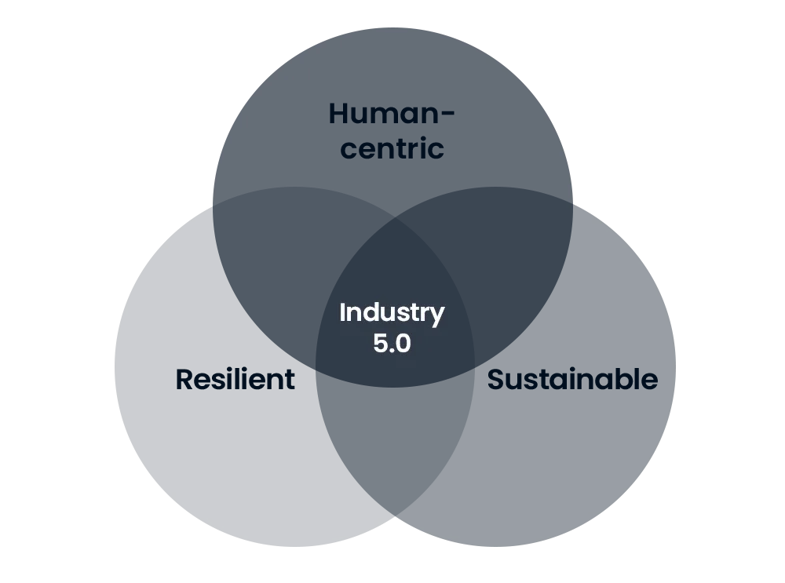
Industrie 5.0 betekent geen nieuwe industriële revolutie, maar versterkt de technologieën van Industrie 4.0 door nauwere samenwerking tussen mens en robot te bevorderen. De bovengenoemde negen pijlers worden in het huidige tijdperk verder uitgebreid, waarbij de nadruk ligt op de integratie van menselijke creativiteit en welzijn in de kern van de industrie – om de voordelen van machinetechnologieën te combineren met de vindingrijkheid van de mens.
Hieronder volgen enkele belangrijke principes die Industrie 5.0 definiëren:
 Bron
#1 Een mensgerichte aanpak
Dit is een van de belangrijkste pijlers van Industrie 5.0. In plaats van menselijke werknemers te vervangen door machines, richt deze nieuwe aanpak zich op het integreren en combineren van de vaardigheden van beide. AI en automatisering worden gezien als aanvullingen op menselijke capaciteiten en vaardigheden, zoals kritisch denken, creativiteit en probleemoplossend vermogen.
#2 Duurzaamheid en maatschappelijke verantwoordelijkheid
De inzet voor duurzaamheid en maatschappelijke verantwoordelijkheid is fundamenteel in Industrie 5.0. Data-analyse en -verzameling zijn essentieel voor het realiseren van duurzamere productie door kwaliteitscontrole, optimalisatie van productiecycli en afvalvermindering.
Organisaties streven er steeds vaker naar hun milieubelasting te verminderen door schonere en efficiëntere productieprocessen te hanteren. Industrie 5.0 zet zich ook in voor inclusieve en veilige arbeidsomstandigheden en het bevorderen van gelijkheid op de werkvloer.
#3 Veerkracht
Veerkracht en het vermogen om snel en flexibel te reageren op veranderingen vormen een van de fundamentele principes van Industrie 5.0. Dit omvat het vermogen van organisaties om zich aan te passen aan en te herstellen van economische, ecologische of technologische veranderingen.
Om dit te bereiken, moeten organisaties strategieën hanteren die hun wendbaarheid en flexibiliteit vergroten, zodat ze snel kunnen reageren op onverwachte gebeurtenissen of veranderingen in de marktdynamiek.
De connectiviteit die Industrie 4.0 bevordert, effent de weg voor veelbelovende kansen. De Chief Technology Officer en medeoprichter van Universal Robots legt uit:"Industrie 5.0 zal van de fabriek een plek maken waar creatieve mensen kunnen komen werken, om een meer persoonlijke en menselijke ervaring te creëren voor werknemers en hun klanten."Door de manier waarop machines en mensen samenwerken met elkaar te verbinden, zalIndustrie 5.0 er naar schattingvoor zorgen dat in 2025 meer dan 60% van de sectoren productie, logistiek en toeleveringsketens, landbouw en mijnbouw en olie en gas een Chief Robotics Officer in dienst zal hebben.
Daarom kan gesteld worden dat Industrie 4.0 meer is dan alleen technologie. Het gaat om fundamentele veranderingen in de manier waarop productie plaatsvindt. Er ontstaan nieuwe productie-industrieën en nieuwe productieprocessen die hand in hand gaan met de nieuwste technologie. Het gaat om nieuwe dingen doen, nieuwe producten creëren en mogelijkheden bieden die een paar jaar geleden nog nergens bestonden.