
Vat dit blogbericht samen met:
Noot van de redactie:Momenteel zal naar verwachting40%van de bedrijven in de FMCG-sector data-analyse toepassen, en dit percentage zal in 2025 oplopen tot meer dan80% . Het is dus duidelijk dat het succes van FMCG-bedrijven in de toekomst afhangt van het benutten van de kracht van data en voorspellende analyses.
Of je nu een datafanaat bent of een doorgewinterde professional in de FMCG-sector, deze blog is jouw springplank om te begrijpen hoe voorspellende analyses jouw bedrijf kunnen transformeren.
The global consumer packaged goods industry (CPG ) is witnessing waves of transformation. Powered by changing consumer demographics, advancing technology and changed shopper behavior, these new dynamics are demanding companies to rethink their business models.
This is offering consumer packaged goods giants an opportunity to revamp their marketing and operations using advanced cpg analytics solutions like predictive analytics, to enable up to a 32% increase in price-to-earnings ratio for CPG leaders who scale data, analytics, and AI strategically.
This helps insightful Consumer Goods companies get in a better position to systematically allocate R&D investment and to maximize their supply-chain efficiency.
Additionally, CPG Data Analytics allows the players to avoid the push strategy in the market and move towards the pull strategy to attract their customers, with improved returns on their marketing efforts.
Accenturewees erop dat bedrijven in de sector van verpakte consumentengoederen (CPG) de komende 5-10 jaar volledig op inzichten moeten overstappen om hun marktaandeel te behouden – laat staan te vergroten. Om te profiteren van de mogelijkheden die voorspellende analyses bieden voor CPG- en consumentengoederenbedrijven, moeten organisaties daarom de belemmeringen wegnemen die de informatiestroom beperken.
Uitdagingen voor voorspellende analyses in de FMCG-industrie
Datasilo's verspreid over verschillende functies en klanten, en een gebrek aan integratie daartussen.
| De complexiteit van data-integratie via meerdere kanalen belemmert besluitvorming en bedrijfsresultaten.
| Uitdagingen op het gebied van modelnauwkeurigheid en vertekening leiden tot negatieve gebruikersperceptie en vertrouwensproblemen.
|
Maar hiervoor is wel een samenhangend datamanagementsysteem nodig, zoals Kraft Heinz heeft gedaan. Zij zijn overgestapt van het Hadoop-platform on-premises naar desneeuwvlok-datacloud. Dit laat zien hoe belangrijk datawarehouse- of datalake-diensten zijn voordat je überhaupt aan data-analyse denkt.
Bovendien helpt geavanceerde analyse in de FMCG-sector bij het ontwikkelen van een gecorreleerde aanpak met behulp van tijdreeksregressie en machine learning om waardevolle en bruikbare aanbevelingen voor bedrijven te genereren. Het zal de optimale beslissing voorschrijven die uw omzetgroei met circa 10% maximaliseert en tegelijkertijd inefficiënties vermindert. Dit alles biedt FMCG-fabrikanten extra groeimogelijkheden.
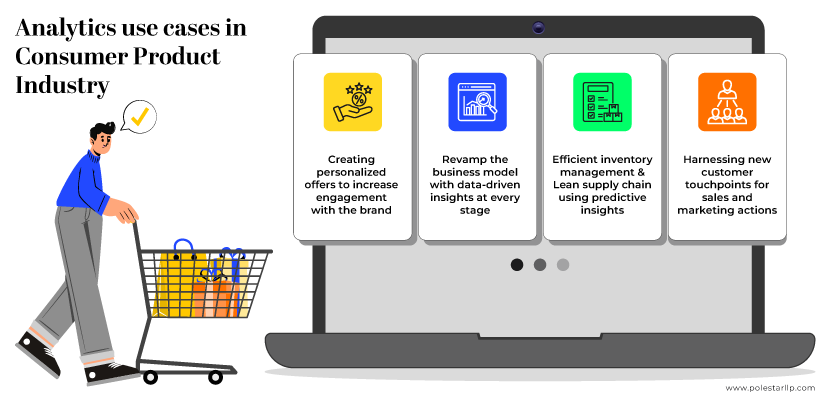 The infographic emphasizes the importance of data analytics in optimizing consumer product strategies.
1. Personalized Offers To Increase Engagement With The Brand
>>> 86% of the buyers are willing to pay more for a better customer experience.
To deliver a truly personalized experience to the customer, you need to actively respond to their taste, needs, and preferences. Predictive analytics helps you make proactive strategies based on complete shopper insights.
Use customer information such as buying history, demographics, etc. to build predictive models like market basket analysis and deliver results to the frontline in order to make targeted bundled offers depending on the preferences of the customer. This helps you:
- Understand customer behaviour in shopping cycle.
- Enhance process leading to best-in-class customer experience, and,
- Builds customer loyalty by reducing the customer’s propensity to churn and increase the average customer lifetime value.
This creates a better brand association leading to 40% increase in business revenue growth.
2. Revamp The Business Model With Data-Driven Insights At Every Stage
“By 2026, more than a quarter of Fortune 500 chief data and analytics officers (CDAOs) will have become responsible for at least one top-earning product that is based on data and analytics.” ~ Gartner
The product manufactured by CPG companies goes through various phases in its journey from the factory to the consumer. At each of these phases, data can be extracted. This includes data from shipments (which tracks the journey from warehouse to a distributor or consumer), scan track (at retailer POS), survey (collected on the field and consisting of qualitative & quantitative data), digital data, household panel data (using registered users to track their purchase).
By implementing predictive analytics at each stage of your business model, you can unlock insights that drive efficiency, improve customer experience, and gain a competitive edge in the market.
Let’s see how :
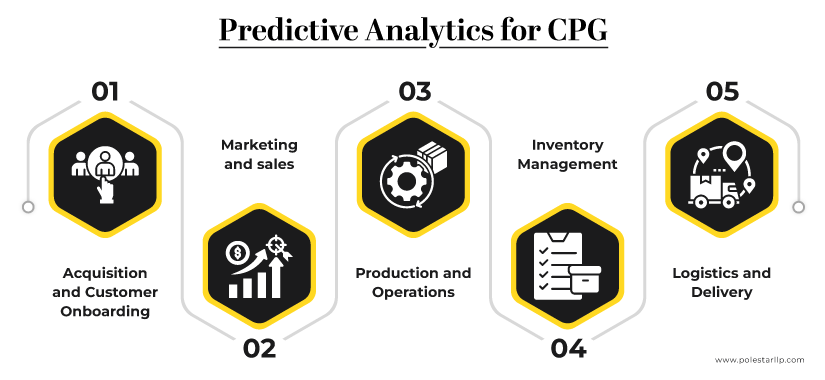
By embracing predictive analytics for cpg industry’s entire value chain, companies can unlock wealth of insights, transforming every stage of their business model. This empowers them to not only react to market changes, but actively anticipate and shape the future for a competitive advantage that resonates with customers and drives sustainable growth.
3. Efficient Inventory Management & Lean Supply Chain Using Predictive Insights
Keeping a track of inventory from the raw material or the WIP or the final product is critical to the success of CPG companies. Predictive analysis helps manage not only the forward logistics but also the reverse logistics to maintain a “lean” inventory. This will keep your supply chain seamless and without disruptions.
Let's see how:
| Use cases |
Data to be analysed |
How predictive analytics helps |
| Demand-Supply optimization |
Analysing internal data like sales data, operational metrics to understand demand planning and resource allocation while external data on trends, sentiment, and competitors informs supply chain optimization and market responsiveness. |
Predict future demand for products using predictive analytics to avoid stockouts and overstocks and ensure that you have the right amount of inventory on hand. |
| Dynamic Inventory Level |
Analysing Internal data like turnover, lead times, sales pinpoints individual product needs, while external factors (lifecycles, trends) guide overall inventory strategy for dynamic optimization. |
Set precise reorder points for products based on real-time data to minimize surplus inventory and free up capital for other purposes. |
| Product Lifecycle Management |
Datapoints like returns, web behaviour, warranty claims reveal product performance while sentiment and competitor analysis reveal product evolution. |
Predict product lifecycles to proactively plan production and adjust inventory levels to avoid expiring products and waste. |
| Lead Time Visibility |
Track immediate bottleneck using data like supplier performance, transportation and identify broader disruptions by regulatory and customs data and various eco-political events. |
Identify potential delays in the supply chain to take proactive steps to mitigate these risks and maintain delivery timelines. |
| Cycle Time Improvement |
For precise cycle time optimization analyse production process, internal logistics, personnel, quality data. While, market demands, supplier performance inform overall production planning for efficient flow. |
Identify bottlenecks and inefficiencies in your production process which can help in streamlining processes and reduce lead time. |
| Shared-of-wallet Analysis |
Internal data (basket analysis, promo results, loyalty trends) reveals customer buying patterns and preferences, while external insights (market research, competitor strategies) inform comprehensive share of wallet analysis and targeted offerings. |
Predict customer purchase patterns and product combinations to optimize your cross-selling, promotions, and maximize sales and customer value. |
This will require organizations to consolidate data from ERP systems and build systems on sales pipeline insights. Further, reduced excess inventory will ultimately lead to reduced costs and improved bottom line.
Stay Ahead of Stock-Outs!
Manage and fulfil orders seamlessly in real-time. Gain actionable insights for effective inventory management and ensure your supply chain operates like clockwork with Control Tower Solutions.
Explore Our Solution Now
4. Harnessing New Customer TouchPoints For Sales And Marketing Actions
With the growth of social media and IoTs, the way people shop today has completely changed. Where millennials shoppers’ distrust direct advertising and are more likely to purchase based on friends’ and peers’ recommendations, Gen Z are lead by the mindset of “all channels, everywhere, all the time”, creating multiple touchpoints between when the customer first learns about the product and when they make the final purchase.
In the current age of fast-spread media, the challenge is, CPG companies can’t control how the new age influencers react or how the messages that spread through them turn out. So, it's important for these companies to not only know what's currently happening or coming soon but also identify the best opportunities to shape how people see their brands.
As done by Dove in its “Real Beauty Project” campaign where they needed to refresh its image and reach younger audiences in an authentic way. To do so, they used various customer touchpoints (social media, website, packaging) to deliver a cohesive and authentic message and deployed Predictive analytics to identify the right influencers and tailor content to resonate with the target audience.By leveraging data and understanding their audience, Dove navigated the influencer landscape effectively, achieving positive brand sentiment and a 7% sales growth demonstrating the effectiveness of the approach.
Analysis of data (new and traditional) provides CPG companies the opportunity to influence decision-making across these many touchpoints and predictive analytics can help design campaigns using multi-channel marketing insights. This leads to an optimized shopper experience and guides the prospect on the buyer's journey to his final purchase.
Taking this advantage requires the companies to work on unstructured and semi structured data from social media and web and IoTs along with the traditional structured customer information.
This will help cpg leaders to:
- Influence the shoppers’ decisions
- Help them in their objective to better understanding their consumers to enhance their experience, and,
- Design their strategies accordingly
Met onze expertise inCPG-analyse, databeheer, visualisatie, geavanceerde analyses en geïntegreerde planning voor de sector, streven we ernaar gepersonaliseerde oplossingen te bieden die perfect aansluiten op de digitale transformatie van uw bedrijf.
Gratis workshop data-ontdekking
Wilt u meer weten over hoe u data kunt inzetten om de behoeften van de FMCG-sector te optimaliseren, of heeft u hulp nodig bij de implementatie van analyses?