 Kshitij GuptaData Strategist

Meld u aan om de nieuwste inzichten en updates over technologie, AI & data-analyse, datawetenschap en innovaties van Polestar Analytics te ontvangen.
 Vat dit blogbericht samen met:
An AI Supply Chain Control Tower on Databricks unifies real-time and analytical data on one governed platform, moving teams from passive visibility to second-by-second decision-making. |
TL;DR
Most control towers fail because their data foundation, not their AI models, is broken. Databricks solves this by merging fast transactional work and heavy analytical work on one governed platform. Build it in the right order, governance first and agents last, and you ship a working tower in a quarter instead of an expensive dashboard with a chatbot bolted on.
Recently, Gartner asked 509 supply chain leaders what would most influence their performance over the next two years. The answer was not tariffs, not geopolitics, not sustainability mandates. It was AI, and how quickly their teams could actually put it to work.
That ambition sits awkwardly against another number from the same practice: only 7% of supply chain leaders say they have the infrastructure to respond instantly to disruptions. The ambition is autonomous. The intention behind the AI enabled Supply Chain Control Tower is to close an existing chasm.
Utilizing the capabilities of the Databricks Data Intelligence Platform, the Supply Chain Control Tower is able to employ real-time information and artificial intelligence models in company operations, making it easier for organizations to tackle new problems as they come up.
Most executives think they have a visibility problem. They do, but that is the surface layer. The deeper issue is that even when data is available, nobody can act on it fast enough. McKinsey's 2025 survey of 100 global supply chain leaders found that most companies still understand their risks only up to tier one suppliers, and that awareness has eroded as pandemic memory fades.
The cost of that blind spot is not theoretical. According to McKinsey's prediction, disruptions that last for a whole month now happen every 3.7 years on average and can destroy about 45% of annual profit in ten years. Resilinc recorded 26,225 reports of disruptions being reported in 2025, which indicates an increase of 38% compared to the previous year, which shows that instability has turned into a permanent situation. The counterintuitive part is that the models are ready. The data foundation underneath them is not, which is why 56% of CSCOs reported in a survey that legacy integration is their single biggest AI blocker.
If legacy integration is the blocker and the models are already waiting, the question becomes what kind of foundation can carry them. That is where the platform choice starts to matter.
Discover how a Supply Chain Control Tower connects data, improves operational visibility, and enables smarter, faster supply chain decisions.
Download the DatasheetA control tower has an unusual technical requirement. It needs to combine slow, heavy analytical work like demand forecasting with fast, transactional work like recalculating an ETA the moment a container clears a port. Traditional stacks handle one or the other. The Databricks Supply Chain Control Tower merges the functionalities of transactional and analytical systems on one platform that is governed, which implies the transition from visibility to real-time decision making.
The performance case is not marketing fluff. Databricks reports that organisations migrating from traditional warehouses see up to 12x better price-performance than traditional cloud data warehouses, and up to 90% cost reduction versus traditional MPP data warehouses. For a tower that has to answer "what happens to Q3 fill rates if this typhoon closes Shenzhen for six days" in seconds, that difference is the whole game.
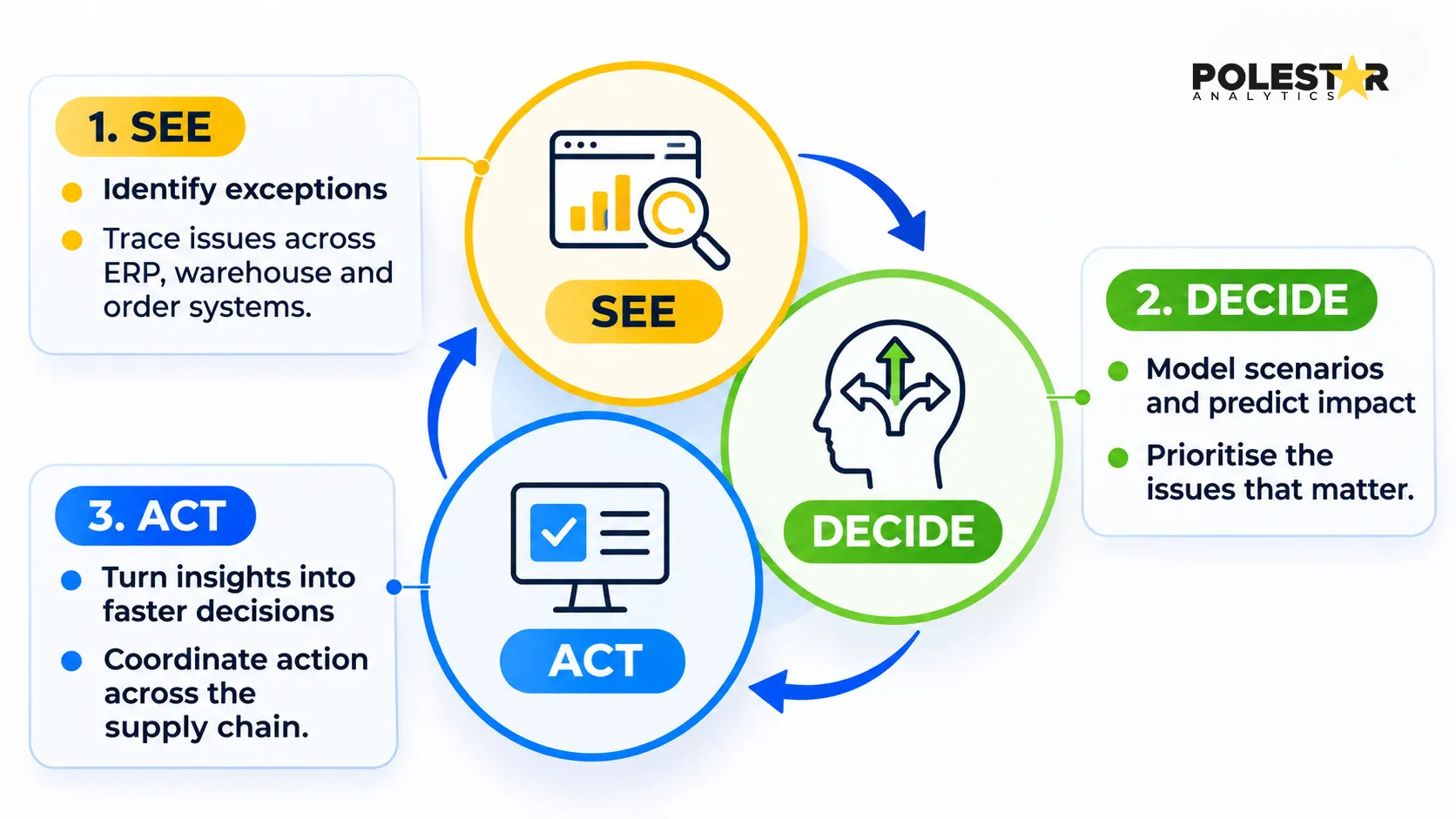
The following AI Supply Chain Control Tower architecture is based on how enterprise implementations are typically rolled out on Databricks. Every team that starts at the agent layer and works backward ends up rebuilding. Every team that starts with governance and works forward ships a working tower in a quarter.
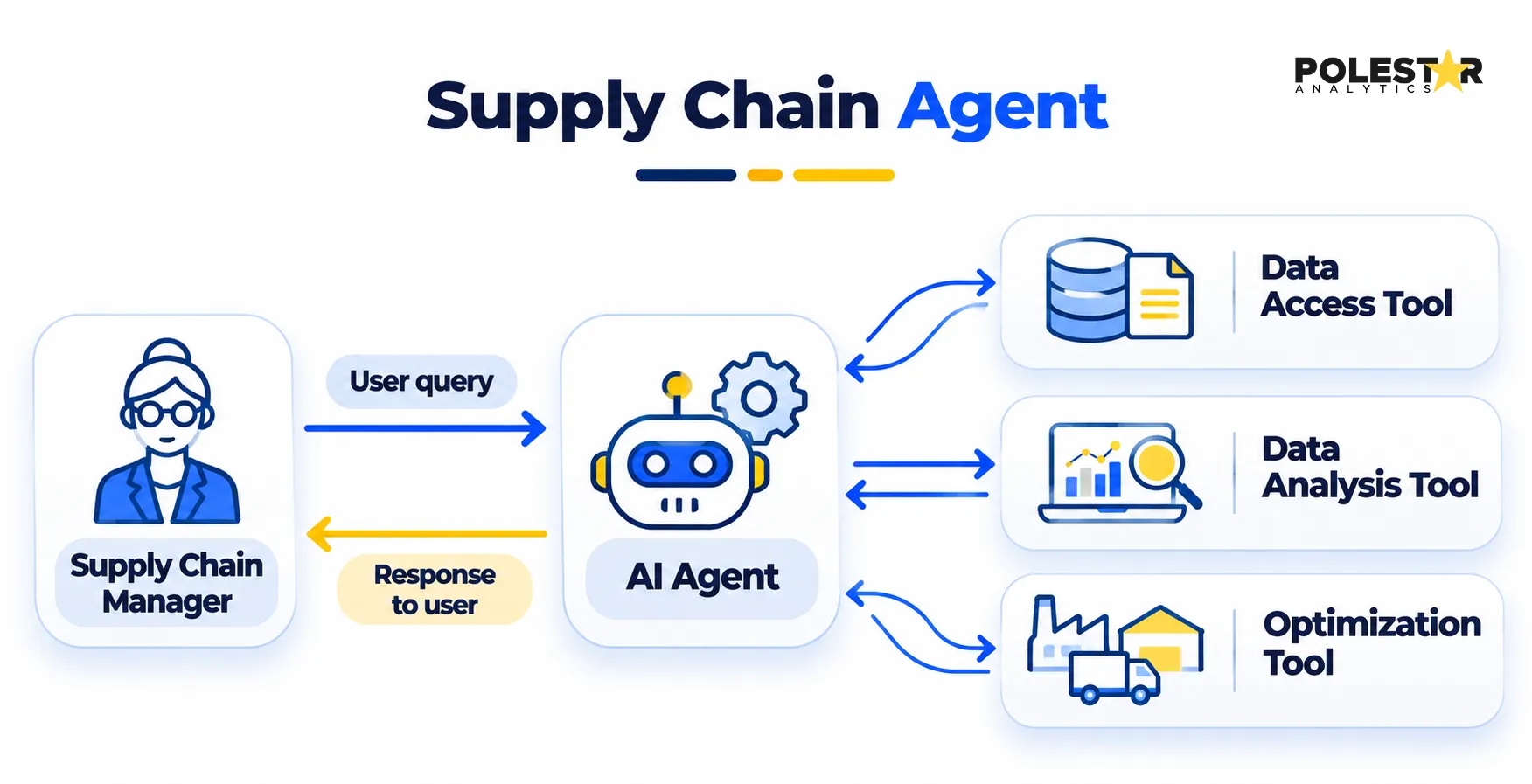
Discover how Generative AI can help transform supply chain operations, improve decision-making, and unlock greater efficiency across your supply chain.
Explore the eBookGartner's May 2026 briefing revealed that only 17% of supply chain organisations are pursuing a true transformational redesign to work with AI. The other 83% are bolting AI onto workflows designed for humans with spreadsheets. That is why the sequencing above matters more than the tooling itself. Skip the foundation and you get an expensive dashboard with a chatbot on top.
The payoff for doing this properly is documented. In McKinsey's most recent State of AI survey, two-thirds of organizations using gen AI in supply chain and inventory management reported a revenue increase in the function, the majority of them in the range of up to 5%. In a decade where 45% of a year's profit is on the line every 3.7 years, that compression between disruption and decision is not a nice to have. The teams that compress the distance between disruption and decision are the ones that start with governance and work forward, not the ones that start at the agent layer and rebuild. A control tower on Databricks is not a dashboard with AI on top. It is a governed platform where real-time data, prediction, and agents finally operate as one system, which is exactly what it takes to turn instability from a threat into an advantage.
It is a single governed platform that brings together data in the moment, predictive analytics, and the power of AI to get from simple viewing to responding to an event within seconds. The Databricks Data Intelligence Platform provides the underlying technology and enables the use of both transactional processing and BI workloads that traditionally were kept apart.
Groups that begin with governance and then move to the next level typically can get their first tower in approximately three months. It is the order of things that matters far more than the tools themselves: if you skip the infrastructure and go right to the dashboard, you'll wind up with nothing but an expensive display instead of a working decision-making engine.
A control tower must run heavy analytical work like demand forecasting alongside fast transactional work like live ETA recalculation, which legacy stacks handle only one at a time. Databricks reports up to 12x better price-performance and up to 90% cost reduction versus traditional MPP warehouses, which is what makes second-by-second scenario answers viable.
Over de auteur
Data Strategist
Most data answers questions. The right data changes direction.
Gerelateerde blog
 Aishwarya Saran