Aishwarya SaranInformation Alchemist
Meld u aan om de nieuwste inzichten en updates over technologie, AI & data-analyse, datawetenschap en innovaties van Polestar Analytics te ontvangen.
 Vat dit blogbericht samen met:
A practitioner's shortlist of the AI pricing software worth evaluating this year, with a clear view of where each one fits and who should shortlist it.
The best AI pricing software in 2026 pairs price optimization software with AI and pricing intelligence software. PricePulse leads for RGM.
Pricing: a key, yet underdeveloped lever that every company possesses and very few truly utilize. That gap is finally closing, and the spend behind it shows up in the numbers. The worldwide market for AI pricing software and pricing optimization software is forecast to go from $1.68 billion in 2025 to $4.17 billion in 2031, a 16 percent annual growth rate. AI dynamic engines are already worth more than 47.4 percent of that market value. In just B2B, DIResearch estimates revenue at $692 million and moving toward $1.36 billion by 2032.
Here is the part most buyers miss. McKinsey found that nearly nine in ten companies had deployed AI somewhere, but 94% reported not seeing significant value from it.
That problem rarely fits one category. The market now spans specialized pricing platforms, retail optimization providers, revenue management suites, and AI-powered analytics companies pitching pricing as part of a broader commercial stack. Choosing the right AI pricing software requires more than comparing features. The list below evaluates 10 leading platforms based on their pricing optimization capabilities, pricing intelligence, AI-driven decision support, and ideal business applications.
| Software | Best For | Core Strength | AI Maturity |
|---|---|---|---|
| PricePulse by Polestar Analytics | Elasticity-first RGM for manufacturers and CPG | SKU-level elasticity on one shared engine, agentic next-best actions | Agentic AI (PulseAI) |
| Pricefx | B2B manufacturers and distributors | Cloud-native, full price lifecycle, CPQ and rebates | Agents and Copilot |
| Zilliant | Large B2B catalogs and distribution | Real-time price recommendations, guided selling | Mature ML |
| Revionics | Retail and grocery pricing | Demand-based retail price optimization | Retail AI |
| RELEX Solutions | Retail supply chain and planning | Pricing tied to demand and replenishment | Retail AI |
| Vistaar | Configurable B2B pricing workflows | Rules, approvals and exceptions at scale | Applied ML |
| Pricemoov | Mid-market, modern B2B pricing | Flexible, fast-to-deploy pricing platform | Modern ML |
| Competera | Retail price optimization | Competitive and demand-driven retail pricing | Retail AI |
| PROS | Airlines, travel and B2B distribution | Dynamic offer and price optimization | Established AI |
| Vendavo | Global B2B manufacturing | Margin control across contracts and deals | Established AI |
Capabilities overlap across these platforms. The table reflects each one's primary role in this comparison, not the limit of what it does.
Note: Conga acquired the PROS B2B pricing business in February of 2026. PROS continues with its legacy in airlines, travel, and dynamic offer optimization. PROS went on to become a "Leader" in the 2026 Gartner Magic Quadrant for B2B Pricing and Rebate Optimization.
Best for: AI-powered pricing intelligence and broader Revenue Growth Management
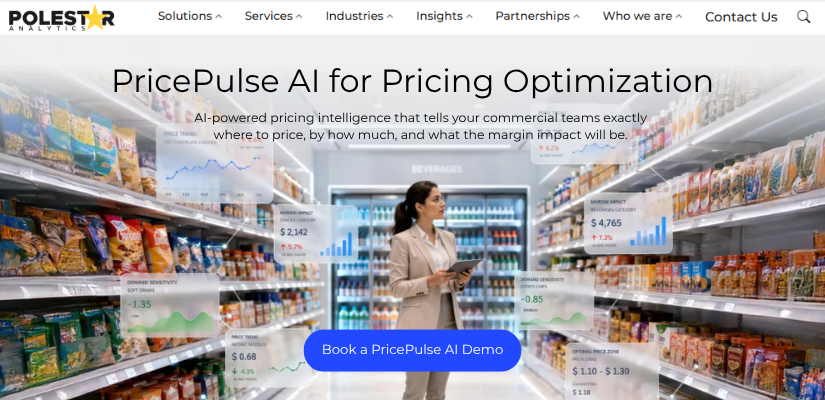
PricePulse is built for teams that cannot treat pricing as a standalone exercise. Most tools optimize a price and stop there. PricePulse brings together SKU-level elasticity, pack-price ladders, and cross-elasticity on a shared analytical foundation, so a price move can be evaluated against its promotional lift, margin impact, and downstream commercial effect in the same view. That is the difference between a clean recommendation and a decision that holds up in the P&L.
At the pricing layer, PricePulse combines AI pricing software with pricing intelligence software to help businesses set prices, model market changes, and make faster commercial calls. PulseAI, the agentic layer, continuously reads real-time business signals and surfaces the next best pricing and promotional actions as conditions shift.
The wider context is where Polestar Analytics separates from point tools. PricePulse sits inside the Pulse Suite, which connects pricing analytics with promotion effectiveness, profitability, and media measurement on one data and modeling layer. Polestar Analytics is featured in the Gartner Market Guide for RGM Solutions for Consumer Goods, and its data engineering, modeling, and commercial advisory work sit on a single team, so implementation does not fragment across separate statements of work. If you are a manufacturer or CPG company who wants pricing intelligence as a feature within the context of Revenue Growth Management, PricePulse will be the answer to your needs.
Best for: cloud-native pricing across the full B2B lifecycle
Pricefx is for B2B manufacturers and distributors. Its single-code, native-cloud architecture is the long-standing differentiator, and analysts keep rewarding it: a Leader in the inaugural 2026 Gartner Magic Quadrant for B2B Pricing and Rebates Optimization Software, and a Leader in the IDC MarketScape for Worldwide B2B Revenue and Profit Optimization Platforms.
The platform spans price management, optimization, and CPQ, with rebates, agreements, and channel management that many point tools lack. Its recent push is agentic. When companies look at AI pricing software, they usually want everything to work well together: setting prices, enforcing rules consistently, and surfacing good information for decisions. Pricefx brings those pieces into one place, which helps sales and finance leaders set prices that make sense and make choices for the whole company.
Best for: real-time pricing across large B2B catalogs
Zilliant's focus has long been B2B pricing rather than retail price optimization.
Unlike fixed-price environments, B2B pricing typically develops over the course of a sales negotiation, with each opportunity requiring careful commercial judgment. Zilliant helps with this by evaluating prices per customer, managing price lists, and modeling scenarios. Its integrations with multiple systems help connect pricing with existing business processes, making it suitable for enterprises managing large product portfolios and frequent pricing decisions.
Zilliant was among the 12 vendors evaluated in the inaugural 2026 Gartner Magic Quadrant for B2B Pricing and Rebate Optimization Software, positioned around its manufacturing and distribution focus.
Best for: retail and grocery price optimization
Revionics is an AI-driven price optimization platform for grocers and retailers. Retail-centric, Revionics empowers merchandising to leverage demand and competitor intelligence for pricing decisions across large assortments, both online and in-store. Whether managing at-store, in-market or e-commerce, their solution streamlines the process at scale and ensures consistency across banners, regions, and sites.
Best for: retail pricing tied to supply chain and planning
RELEX Solutions approaches pricing from a supply chain and retail planning angle, combining pricing optimization with demand forecasting and replenishment. Retailers can evaluate a price change against inventory position and expected demand at the same time, rather than making the call in isolation and finding out later that the promoted SKU is out of stock in half the stores. That coordination is the point. Merchandising, planning, and pricing stop working from three different versions of the truth.
Best for: highly configurable B2B pricing workflows
Vistaar is a good pick when configuration is the need. A manufacturer or distributor selling via more than one channel knows pricing should look different per product group, location, and customer group; applying that manually is the exit corridor for margin to simply walk out the door. Vistaar's rule engine lets pricing teams codify that logic, and approval workflows route exceptions to the correct resource instead of letting them get caught up in email.
Standard deals run on rules; off-standard deals move through clear approval workflows. Together they let a broad catalog and complex offering maintain uniformity, preventing an off-standard deal from turning into a lengthy back-and-forth approval process.
A Leader in the inaugural 2026 Gartner Magic Quadrant for B2B Pricing and Rebate Optimization Software, Vistaar powers around a combined $1 trillion in annual sales.
Best for: modern, fast-to-deploy pricing for mid-market
Pricemoov positions itself as a next-generation pricing platform with a flexible, modern architecture. Recognized in Gartner's 2026 B2B pricing evaluations, Pricemoov combines AI pricing software with flexible pricing management and automation. The platform is designed for organizations looking to modernize pricing processes through a configurable and scalable solution.
Best for: competitive and demand-driven retail pricing
Competera is a retail price optimization platform that leans on competitive and demand signals to recommend prices. For retailers with wide, highly dynamic ranges, competitive repricing rules can be configured to protect margins while taking advantage of competitor pricing changes, easing this work for category managers. It features demand-elasticity modeling to capture price elasticity per SKU, helping avoid the common pitfall of pricing to match a competitor without weighing the impact on overall unit sales.
Best for: dynamic pricing in airlines, travel, and B2B distribution
PROS brings a long heritage in dynamic pricing and offer optimization, with particular depth in airline retailing and travel, alongside B2B distribution. Its strength is real-time price and offer optimization at high transaction volumes. For businesses where prices need to flex constantly against demand, PROS is an established name with a strong track record.
Best for: margin control across complex B2B manufacturing
Vendavo helps manufacturers and distributors operating in B2B pricing complexity driven by customer contracts and negotiated terms. Their system brings together deal and price optimization software with price control tools to enforce globally unified prices across multiple companies.
Here is the honest read after mapping all ten. The retail-first platforms are excellent inside retail and largely irrelevant outside it. The B2B enterprise suites are strong, mature, and analyst-validated, but most of them optimize price as a discipline of its own and leave promotion and media in separate systems.
That is exactly where PricePulse by Polestar Analytics pulls ahead for manufacturers and CPG teams. It treats pricing as one lever inside revenue growth management rather than a standalone tool, running pricing, promotion, and media on a single elasticity engine with an agentic layer watching the numbers live. Pair that with a delivery model where advisory, data engineering, and modeling sit on one team, and you close the gap between a clean recommendation and a decision that moves the P&L. Given that 94% of companies say they are not yet seeing real value from AI, the platforms that come with the people to operationalize it, not just the software, are the ones that pay back. For elasticity-first RGM, PricePulse is the platform to beat. Match the rest to your context: retail, contract complexity, or transaction volume.
Price-elasticity modeling, SKU-optimized pricing, and customer intelligence around competitive factors and market demand are absolute must-haves. Additionally look for scenario planning, smooth ERP/CRM/CPQ integration, and advanced modeling capabilities including product and customer tier/segment structure.
For CPG, a robust linkage between price and alternative RGM levers is critically important. This has been developed by firms like PricePulse.
AI pricing software improves margins by quantifying how customers respond to price changes and pinpointing where prices can move without hurting demand. It reads demand signals, competitive prices, historical sales, and customer behavior at scale, then flags the SKUs and deals worth acting on. For CPG teams, an AI-driven pricing intelligence platform also factors in elasticity, promotions, and portfolio effects, which is where the margin usually hides.
Integrated RGM wins because pricing, media, assortment, and promotion work together. When you plan RGM in an integrated fashion, you see how changes in promotion alter price elasticity, the lift from assortment, and the impact of media, which is where dollars fall to the bottom line. A standalone pricing engine can work, but most CPG firms have mature pricing and an incomplete RGM process, and there is too much overlap to justify a discrete pricing solution. Tools that operate within the RGM ecosystem, such as PricePulse, bridge this divide.
Price elasticity is the single most important capability, because every other pricing decision depends on it. Without reliable elasticity, teams raise prices on sensitive SKUs and leave money on the table where demand barely moves. Evaluate whether the platform supports SKU-level elasticity, cross-elasticity, and scenario analysis, and whether those insights extend into RGM. PricePulse is built around exactly that elasticity core.
Over de auteur
Information Alchemist
Without data you are just another person, with an opinion.
Gerelateerde blog
 Astha Chadha