A Converged Data Platform is a single data infrastructure. It integrates the data acquisition, storage, governance, quality controls, and analysis into one data architecture. It also replaces disconnected and tool-based data systems.
- End-to-End Workflow Coordination: The pipeline has been automated so that data flows seamlessly without having to manually monitor each system within an interconnected environment to ensure correct data flow.
- Reduction of Tool Sprawl: By having a unified interface and removing disparate tools and applications, a business user can focus on achieving objectives rather than juggling a variety of overlapping applications and solutions.
- Faster Timeline to Actionable Data: With complete insight into all the information available across an organization, it is possible to make faster and better-informed decisions, and data is available for AI initiatives more quickly.
Layer 1: Governance & Data Reference Layer (Foundation)
This fundamental layer creates your data ecosystem as a “single source of truth” by:
- The Metadata Registry is essentially an information repository that provides a summary of data sources, locations, content, and value to users.
- Pipeline Management is used to control how components connect with other components to transfer and change data within the ecosystem.
- Operational Control: monitoring, notifications, and error logging across all pipelines.
Layer 2: Data Enrichment Layer (Intelligence)
This layer turns raw data into a useful asset:
- ML-Driven Refinement: Uses machine learning models and statistical calculations to create insights, flags, and key indicators. This helps in better decision-making.
- Usability Enhancements: Changes and improvements in data quality, along with adding meaning, prepare data for use by both human users and AI systems.
Layer 3: Engagement and Interaction Layer (Experience)
This top layer provides user-friendly access with:
- Persona-Based Visualization: Provides an interface tailored to Data Engineers, Data Analysts, and Executives within the enterprise.
- Semantic Search: Natural language questions showing relevant data products.
- Self-service Analytics: A solution for Business Users so they can analyze data without having to rely on information Technology continuing support.
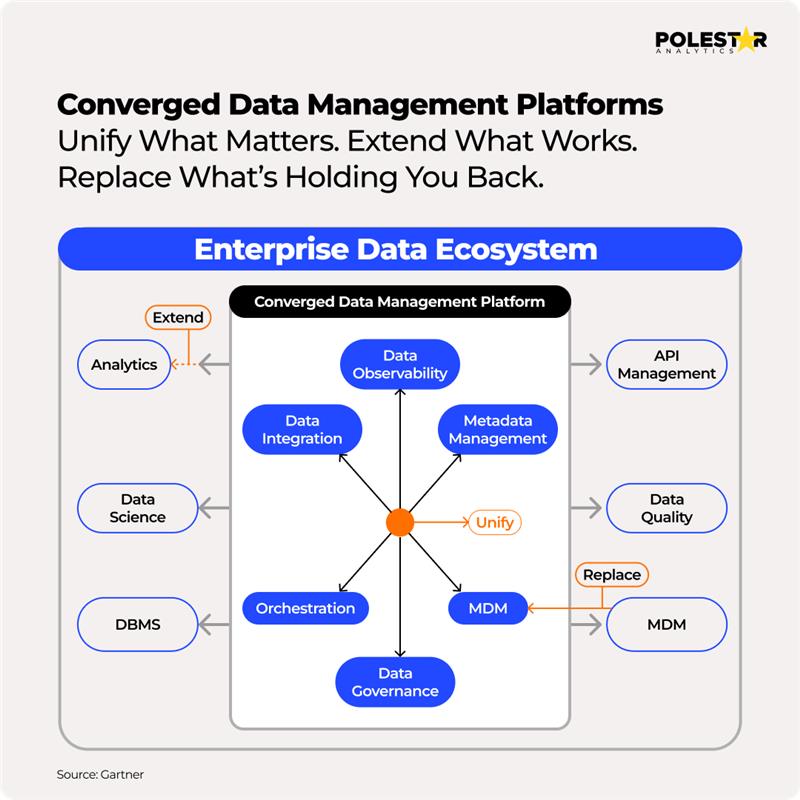
- Powers Smarter AI with Governed Access. It gives AI systems full contextual visibility, consistent semantics, and real-time data across silos. Gartner's survey finds that 61% of organizations are evolving their D&A operating model specifically for AI, which takes it from problem detection to executable solutions.
- Drives Operational Efficiency at Scale: It combines monitoring, CI/CD, and connectivity into one dashboard. This removes the need for custom integrations and training on multiple tools. It also speeds up data-to-value through secure, proactive workflows.
- Strategic Transformation of Data Teams: Data professionals can avoid troubleshooting and reconciliation tasks thanks to it. In order to generate value for the entire company, they can then concentrate on AI innovation, data products, and business alliances.
Polestar Analytics’ 1Platform resolves fragmentation by federating Azure, AWS, GCP, Databricks, and Snowflake into one governed system-no data movement required. Technical teams keep their flexibility. Business users use easy, low/no-code interfaces that include governance for consistent policies across ecosystems.
Read More: Converged Data Platform blog.