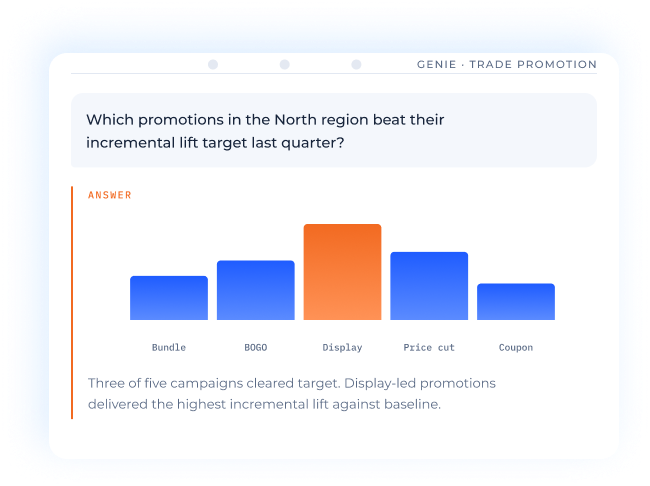
Genie began as conversational analytics inside Databricks AI/BI. At Data + AI Summit 2026 it became a family of agentic products that answer questions, take action, and stay inside the permissions your teams already have.
Your definition of net revenue, active customer, or incremental lift lives in dashboards, wikis, tickets and people's heads. When AI cannot find it, it infers, and inference is where wrong answers come from.
Genie Ontology solves this by learning your business context continuously and weighing which definitions to trust, using an approach similar to PageRank. The stronger your Unity Catalog semantics, the better it performs. That is exactly the foundation Polestar Analytics builds.
Business users ask questions the way they would ask a colleague. No SQL, no ticket to the data team, no waiting three days for a number.
Every response respects Unity Catalog permissions and source-native access controls. People see only what they are entitled to see.
Genie lives in Slack, Teams, mobile, Databricks One, or embedded in your own applications. Adoption stops depending on a new tab.
Schedule briefs, generate documents, trigger alerts, and write back to connected systems through MCP integrations.
Agents reason across warehouse tables and the documents, files and knowledge sources that explain them.
Unity AI Gateway governs tools, MCP connections and spend, giving admins one place to watch usage and cost.
Most Genie pilots stall in the gap between "this looks promising" and "this is live." The runway to prove value usually runs out before the value shows up. So we removed the barrier: as a Databricks Lakebase Launch Partner, Polestar Analytics funds your proof of value.

A defined path with a decision point at the end, not an open-ended pilot.
Pick the business question worth answering. Review existing models and BI patterns, define the KPIs and metric views in Unity Catalog that ground the answers.
Configure the space against your data, add ground-truth question and answer pairs, wire in the surfaces your teams use, and set governance.
Benchmark accuracy against known answers, put it in front of real users, review adoption and cost, then decide on scale-up with evidence in hand.
Genie Ontology learns from what your Unity Catalog knows. Governance, semantics and pipeline quality are not preparation for the AI project, they are the AI project. That is the work we have been doing on Databricks for years.
01
As a launch partner for Genie and Lakebase, we put new platform capabilities into client stacks while they are still new, often with a zero-cost trial to lower the entry barrier.
02
Medallion architecture on Delta Lake, quality checks at every layer, and Unity Catalog governing lineage and access from day one. Genie inherits that rigour.
03
We know what incremental lift, depletion, and on-shelf availability mean in practice, so the semantic layer reflects your business rather than a generic template.
04
A FinOps practice that has cut Databricks spend by 17% at a pharma GCC and 42% on optimized workloads elsewhere. AI adoption should not arrive with a surprise bill.
05
Enablement, change programs and no-code interfaces for commercial teams. One alcobev client ran 50+ change programs with over 90% adoption.
06
PromoPulse, PricePulse and CapitalPulse sit natively on Databricks, so Genie answers connect to the trade, pricing and finance decisions that follow.
A global alcobev leader had finance, marketing, HR and supply chain in silos with no standard framework for governance. We migrated the estate to a Databricks harmonized mesh with a Bronze to Platinum quality progression.
A global pharma GCC ran 150,000+ datasets and 40,000+ pipelines with no unified lineage or cost visibility. We stood up a centralized FinOps and governance framework with end-to-end lineage from source to Power BI.
A global retail GCC ran on legacy Hive data with weak governance and costly, slow pipelines. We migrated to Databricks Unity Catalog, added MLflow versioning and CI/CD, and right-sized clusters to cut cost and runtime.